One Gummy, 25 mg, and What the Studies Measured

Definition
A CBD gummy is a chewable sweet with a set amount of cannabidiol per piece: 25 mg in the Cibdol version, alongside vitamin B12. It is chewed, swallowed and metabolised like any other small food, which is one reason human pharmacokinetic reviews describe oral cannabidiol figures as highly variable [1]. Everything past the label belongs to the research, so that is where this page goes.
The label is exact. Digestion is not.
- One Cibdol gummy carries 25 mg of cannabidiol. The figure comes from the formulation, it is printed on the box, and it is the same in every sweet in the pack.
- Ten gummies per pack, 45 g net weight. A small box with a short ingredient story behind it.
- Each gummy also carries vitamin B12. On the box label it appears under its chemical name, cyanocobalamin, which is the form used in the formula.
- The box states THC-free, in plain words, printed where you can read it before anything is opened.
- Raspberry or mango. That one is a flavour question and nothing else.
- The route through the body is ordinary food handling: chewed, swallowed, digested, then metabolised on the first pass through the liver. Nothing about that path is exotic. A biscuit takes the same one.
- Cannabidiol is fat-soluble and dissolves poorly in water, and the crossing of the intestinal wall is where the variability of oral cannabidiol begins [1].
- Jiang's 2011 work on human liver microsomes identified cytochrome P450 enzymes as the enzymes that metabolise cannabidiol [2].
- Millar's 2018 systematic review of human data reported published values as highly variable, with oral bioavailability described as low and inconsistently determined [1].
- Food is one of the variables running through that literature, and a gummy is food. Taylor's 2018 Phase I trial included a dedicated food effect arm for that reason [4].
- Since 2014, one standard here has not moved: state what is in the pack, describe what has been measured, then stop at the edge of the data.
The route a swallowed sweet takes
Chewing is the first step, and it is the only one anyone notices. After that the gummy behaves like any other small piece of food. It leaves the mouth, passes the stomach, and reaches the small intestine, where absorption either happens or does not. Cannabidiol is fat-soluble with poor water solubility, and Millar's 2018 review names the crossing of the intestinal wall as the origin of the wide spread in oral figures [1]. Whatever gets across then meets the liver before it reaches general circulation. That first pass matters, because enzymes are waiting there. Jiang's 2011 experiments used human liver microsomes, a laboratory preparation made from liver tissue, and identified cytochrome P450 enzymes as the metabolisers of cannabidiol [2]. Cytochrome P450 is a family rather than a single enzyme, and the 2011 paper is a map of which members do the work [2].
Where the published numbers spread out
Millar and colleagues collected human pharmacokinetic data in 2018 and reported values that vary widely from study to study, and inside single studies from participant to participant [1]. The reasons are set out plainly: differing study designs, differing formulations, differing administration conditions [1]. Same molecule, different arithmetic. The reviewers also noted that oral peak plasma concentrations arrive later than inhaled ones, and that oral bioavailability has been both low and inconsistently determined across the literature [1]. So the 25 mg is fixed. What a digestive tract does with 25 mg is not.
Plasma numbers and the clock
Peaks arrive later by mouth
In Millar's 2018 systematic review, oral peak plasma concentrations were reported as arriving later than those following inhalation [1]. The same review describes oral bioavailability as low and inconsistently determined, which means the published record holds a range rather than one accepted figure [1]. Part of the reason is design. The review lists differing protocols, formulations and administration conditions as the source of the spread, and points to absorption across the intestinal wall as the main driver, both between studies and between participants within one study [1]. A single agreed number for how fast 25 mg shows up in blood does not exist in that literature. What exists is a range, gathered under conditions that rarely resemble a Tuesday afternoon.
Fat tissue and the long tail
Huestis published a background account of human cannabinoid pharmacokinetics in 2007, and one point in it explains the long tail: cannabinoids move quickly out of blood into fatty tissue and return slowly [3]. The consequence recorded there is that traces stay detectable far longer than the peak itself lasts [3]. Two caveats belong next to that. Detectable in plasma and noticeable are separate questions, and the 2007 material deals with concentrations rather than sensations [3]. And every figure in this field is a group average taken from study participants, not a personal timetable. Your intestine, your liver, your meal. Populations get described. Individual curves do not get printed.
A gummy counts as food
Food effect is a routine question for anything taken by mouth, and giving it its own arm is a marker of careful design. Taylor's 2018 Phase I trial gave highly purified cannabidiol to healthy participants across three arms: single ascending dose, multiple dose, and food effect [4]. In the food arm the same amount was given fed and fasted, with the meal deliberately controlled so the comparison stayed clean [4]. Plasma concentrations measured after the meal were markedly higher than in the fasted condition [4]. That is the observation, measured under trial conditions and written down. A gummy is food, which is the whole reason a food effect arm has anything to say about a chewable format. Sugar, gelling agent, flavour, 25 mg of cannabidiol and a measured amount of vitamin B12, eaten.
What the trial left open
The 2018 work compared a controlled meal with an empty stomach [4]. It did not map one particular meal onto one particular sweet, and it was never built to. No published study takes a raspberry gummy, a plate of pasta and a set interval, then reports the result. So the fixed part stays fixed: 25 mg per gummy, printed on the box, ten to a pack. The open part is how a given digestive tract handles that 25 mg on a given day, which is precisely where Millar's 2018 review located the variability in the first place [1].
Same route, different formats
A pipette runs the other way
With CBD Oil 2.0 the logic reverses: you count from the pipette and adjust the amount up or down. A gummy has no dial. The 25 mg is set when the batch is made, so the only things left to vary are how many you chew and when. CBD Capsules 2.0 sit on the same swallowed route with a different shell around the contents, which is useful to know if you are comparing labels rather than flavours. Our guide to the best ways to take CBD for your lifestyle lines the oral, sublingual and topical formats up side by side, because the pick usually comes down to routine rather than chemistry. The wider range covers the remainder.
What is still open
Human evidence on cannabidiol is still developing, and individual responses vary. That is the honest end of this page. Millar's 2018 review gathered what exists in humans and reported it as variable, with oral values low and inconsistently determined [1]. Jiang's 2011 paper named the enzyme family doing the metabolising without settling how much reaches the blood [2]. Taylor's 2018 trial measured fed against fasted and reported the difference [4]. We have been working with cannabinoids since 2014, and the standard has not shifted: state the contents, describe what has been measured, stop there.
Frequently Asked Questions
4 questionsHow much cannabidiol is in one Cibdol gummy?
Do the gummies contain THC?
Does it matter whether a gummy is chewed with a meal or on an empty stomach?
Why do published figures for oral cannabidiol vary so much?
About this article


Luke Sholl has been writing about cannabinoids, CBD, and the broader benefits of nature since 2011. His background includes first-hand cannabis cultivation experience spanning the full seed-to-harvest lifecycle across so
This wiki article was drafted with AI assistance and reviewed by Luke Sholl, CBD & wellness writer. Editorial oversight by Joshua Askew.
Medical disclaimer. This content is for informational purposes only and does not constitute medical advice. Consult a qualified healthcare provider before use of any substance.
Last reviewed August 29, 2026
References (4)
- [1]Millar, S.A. et al. (2018). A Systematic Review on the Pharmacokinetics of Cannabidiol in Humans. DOI: https://doi.org/10.3389/fphar.2018.01365
- [2]Jiang, R. et al. (2011). Identification of cytochrome P450 enzymes responsible for metabolism of cannabidiol by human liver microsomes. DOI: https://doi.org/10.1016/j.lfs.2011.05.018
- [3]Huestis, M.A. (2007). Human Cannabinoid Pharmacokinetics. DOI: https://doi.org/10.1002/cbdv.200790152
- [4]Taylor, L. et al. (2018). A Phase I, Randomized, Double-Blind, Placebo-Controlled, Single Ascending Dose, Multiple Dose, and Food Effect Trial of the Safety, Tolerability and Pharmacokinetics of Highly Purified Cannabidiol in Healthy Subjects. DOI: https://doi.org/10.1007/s40263-018-0578-5
Related Articles

Can You Be Allergic to CBD? Two Papers, One Protein
Two published papers characterise a cannabis plant protein called Can s 3 as an allergen. Here is what they cover, what they leave open, and where the carrier oil and softgel shell fit in.
CBD and Ibuprofen: One Shared Liver Enzyme
Ibuprofen depends on a single liver enzyme, and cannabidiol has been described as an inhibitor of it. Here is what the 2011 and 2019 research documented, and where the record simply stops.
CBD That Mixes Into Water: The Actual Chemistry
The phrase exists because of one physical fact: cannabidiol and water do not mix on their own. Here is what emulsions and liposomes actually are, and where the published human measurements stop.
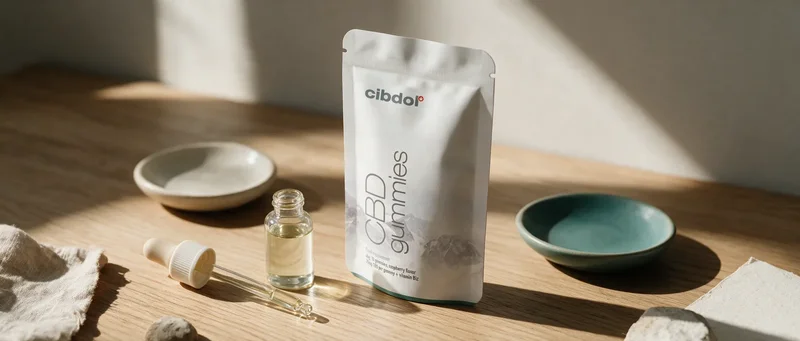
CBD Oil or Gummies: Where the Amount Gets Decided
The pipette leaves the counting to you; the gummy carton arrives with the number already on it. Here is what the published human data covers, and where it stops.
Travelling With CBD: Check Three Countries First
A country-by-country permission list for CBD is wrong by design. Here is the checking order instead: three countries per ticket, the airline's own conditions, and a clear rule for unresolved cases.
What Is A CBD Tincture? The Word And The Bottle
Tincture once described a method: extraction with alcohol. Here is how the word travelled to CBD dropper bottles, and what the ingredient list settles that the front label does not.
Combining CBD Products: Counting The Day's Milligrams
An oil in the morning and a capsule at night belong to the same daily figure, counted in milligrams. Here is how that arithmetic works, what the human pharmacokinetic literature covers, and why a topical sits in a column of its own.

Ways To Take CBD, Route By Route
A pipette bottle, a capsule and a chewable piece are not three sizes of the same thing. They sit on different routes, and published human reviews keep those routes in separate columns.
How much CBD? Start with the liver, not the number
The amount on a label and the amount measured in blood are not the same number, and the human pharmacokinetic record explains why. Here is what the cited research describes about route, liver metabolism, trial design and reading a batch report.
