CBD Half-Life: What The Human Studies Measured
Definition
A half-life is the time it takes for a concentration in the blood to fall by half. For cannabidiol in humans, published estimates run from about one hour to several days, depending on how it was administered and how often. The figure describes a measured curve in a study population, not a personal countdown.
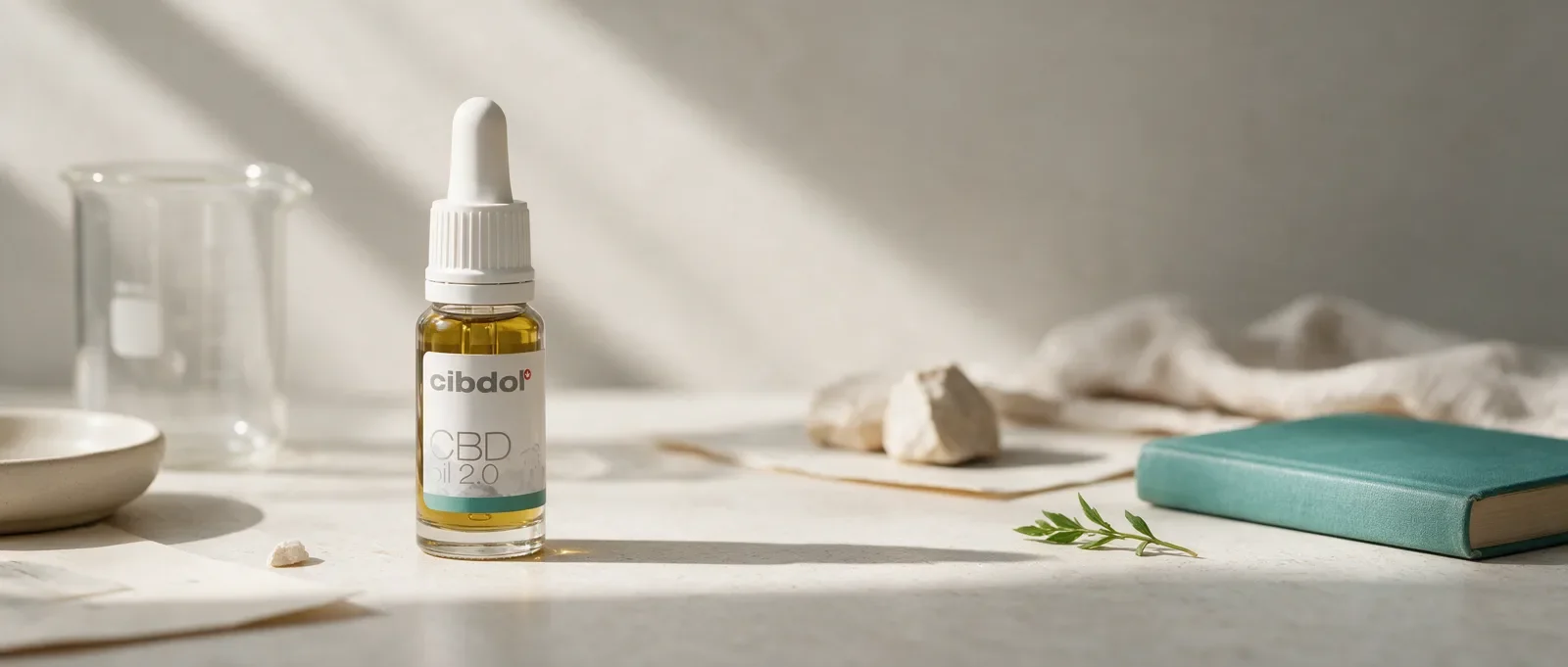
Ten past nine in the evening. The pipette goes back in the cupboard, and one question stays behind: how long does cannabidiol actually stay in the blood? The published answer starts with a definition, and the definition is arithmetic.
Half gone, then half of that again
The arithmetic, step by step
Picture 100 units in plasma at the start. After one half-life, around 50 remain. After two, about 25. After three, 12.5, and the curve keeps heading down in the same proportion from there. Each interval removes half of whatever is left, not half of the original amount. That is why the end of the curve flattens instead of stopping short: the absolute quantity cleared in each step gets smaller every time. A half-life is a rate expressed in time. Nothing more dramatic than that.
An average from a group, not a promise to one person
The number is a population statistic. It comes from participant-averaged measurements, which means a group was sampled, the concentrations were plotted, and one figure was fitted to the result. It is not an individual guarantee. Two people in the same trial can sit on either side of that average and both be entirely ordinary. Same route, same amount, different numbers. So when a review reports a half-life, the scope of the claim is narrow. It describes the shape of a concentration curve in the study population, and nothing beyond it. Read it as a description of data, not as a clock running in your own bloodstream.
From roughly an hour to several days
The 2018 systematic review by Millar collected the human pharmacokinetic work on cannabidiol available at the time [1]. Pharmacokinetics, in plain terms, is the study of how a compound's concentration in the body rises and falls over time. Across the collected studies, half-life estimates varied widely, and the variance tracked two things: route of administration and dosing pattern [1]. The full span runs from about one hour, reported for some single-administration routes, out to roughly two to five days under chronic oral dosing [1]. That is not a small spread. It is the difference between an afternoon and most of a working week. The upper end has an origin that deserves to stay attached to it: chronic oral dosing conditions, meaning repeated administration over time, rather than one single administration [1]. Quote the days after a single pipette and the number has been lifted straight out of the conditions that produced it. This is also why no single headline figure for cannabidiol's half-life exists in the literature. What exists is a set of estimates, each tied to a route, an amount and a schedule [1]. Any honest short answer has to carry those three details with it.
Fat-soluble molecules and a slow tail
The human cannabinoid pharmacokinetics literature reviewed by Huestis in 2007 gives the mechanical reason behind the long end of that range [2]. Cannabinoids are lipophilic, the technical way of saying they dissolve in fat rather than water. After they reach the bloodstream, a portion distributes out of the blood and into fatty tissue [2]. With repeated exposure, that tissue compartment builds up a load, and the compound is released back into circulation slowly [2]. This release becomes the rate-limiting step. Once tissue is holding a store, plasma concentrations cannot fall faster than the tissue hands the compound back [2]. The measured decline in blood then describes a reservoir emptying, not clearance speed on its own. One detail gets skipped often. A terminal half-life measured after chronic dosing reflects slow tissue release, a redistribution phenomenon, and it is not a measure of ongoing activity [2]. Molecules moving between compartments are molecules moving between compartments. The figure tells you where the compound went and how slowly it comes back, and that is the limit of what it tells you [2]. Long tail, small numbers, plenty of time on the clock.
The variables the studies name
Both cited papers name the factors that move the figure, and both stop well short of turning them into a personal calculator [1] [2]. That distinction matters more than it sounds. A named variable means researchers saw it shift the result. It does not mean anyone has published a formula where you enter your own details and get an hour count back. The list is short, and it repays reading slowly rather than skimming.
- Route of administration: how the compound enters the body, the factor the 2018 review ties directly to the spread in reported estimates [1].
- Amount administered: the dose behind each individual estimate, which is part of why the numbers are not comparable across studies [1].
- Frequency of administration: single versus repeated, and this is what separates the hour-scale figures from the day-scale ones [1].
- Body composition: named in the literature as a source of variability, with no per-person predictive figures attached to it [1].
- Metabolic handling: how a given body processes the compound, again named rather than quantified [1] [2].
A curve on paper, not a sensation
These two get merged constantly, and the pharmacokinetic literature keeps them apart. A plasma curve and the duration of perceptible effects are not interchangeable quantities [1]. The metric in the 2018 review is concentration measured in samples, not what participants reported noticing [1]. So a half-life cannot be read as a statement about how long anything lasts. It answers a narrower question: how quickly the measured concentration fell in that study population [1]. Two different questions, two different measurements, one number that only fits the first.
Detection windows sit in their own column
Related, but separate. A detection window depends on the threshold of the assay and on the sample matrix being analysed, so it does not map onto a half-life one to one [2]. What connects them is the tissue story. Slow release from fat can sustain low circulating concentrations long after repeated exposure has stopped [2]. Low is not the same as absent, and a laboratory threshold can sit lower still. That mechanism is the whole link between the two ideas, and it is a mechanism rather than a conversion rate.
Where the human dataset thins out
The 2018 review is direct about its own limits. The human pharmacokinetic dataset for cannabidiol is heterogeneous, with differences in study design and in sampling, and that restricts what can be pooled into one conclusion [1]. So the ranges quoted on this page belong to study populations under study conditions. They were never built to describe individuals outside those conditions [1]. Body composition and metabolism appear there as named sources of variability, and no predictive per-person figures follow from them [1]. For your own number, the accurate position is that it has not been measured. We're comfortable saying so.
The figure that really is measured per bottle
One number does come with a certificate: cannabinoid content. Since 2014 we've published independent batch analyses, so what is in a bottle can be checked against the label before the seal comes off. That figure is milligrams in a batch, verified by a laboratory. It is not a half-life and it does not predict one, because half-life is measured in study participants under study conditions [1]. Different question, different document. The batch report belongs to the bottle. The half-life belongs to the pharmacokinetic literature, and it stays there.
Frequently Asked Questions
4 questionsIs there one figure for cannabidiol's half-life?
Where does the two to five day figure come from?
Does a half-life say how long anything is noticeable?
Why can two people show different numbers?
About this article


Luke Sholl has been writing about cannabinoids, CBD, and the broader benefits of nature since 2011. His background includes first-hand cannabis cultivation experience spanning the full seed-to-harvest lifecycle across so
This wiki article was drafted with AI assistance and reviewed by Luke Sholl, CBD & wellness writer. Editorial oversight by Joshua Askew.
Medical disclaimer. This content is for informational purposes only and does not constitute medical advice. Consult a qualified healthcare provider before use of any substance.
Last reviewed August 27, 2026
References (2)
- [1]Millar, S.A. et al. (2018). A Systematic Review on the Pharmacokinetics of Cannabidiol in Humans. DOI: https://doi.org/10.3389/fphar.2018.01365
- [2]Huestis, M.A. (2007). Human Cannabinoid Pharmacokinetics. DOI: https://doi.org/10.1002/cbdv.200790152
Related Articles
Can You Be Allergic to CBD? Two Papers, One Protein
Two published papers characterise a cannabis plant protein called Can s 3 as an allergen. Here is what they cover, what they leave open, and where the carrier oil and softgel shell fit in.
CBD and Ibuprofen: One Shared Liver Enzyme
Ibuprofen depends on a single liver enzyme, and cannabidiol has been described as an inhibitor of it. Here is what the 2011 and 2019 research documented, and where the record simply stops.
CBD That Mixes Into Water: The Actual Chemistry
The phrase exists because of one physical fact: cannabidiol and water do not mix on their own. Here is what emulsions and liposomes actually are, and where the published human measurements stop.
CBD Oil or Gummies: Where the Amount Gets Decided
The pipette leaves the counting to you; the gummy carton arrives with the number already on it. Here is what the published human data covers, and where it stops.
One Gummy, 25 mg, and What the Studies Measured
25 mg per gummy, ten in a pack, THC-free printed on the box. What happens after chewing is the part human trials are still measuring [1].
Travelling With CBD: Check Three Countries First
A country-by-country permission list for CBD is wrong by design. Here is the checking order instead: three countries per ticket, the airline's own conditions, and a clear rule for unresolved cases.
What Is A CBD Tincture? The Word And The Bottle
Tincture once described a method: extraction with alcohol. Here is how the word travelled to CBD dropper bottles, and what the ingredient list settles that the front label does not.
Combining CBD Products: Counting The Day's Milligrams
An oil in the morning and a capsule at night belong to the same daily figure, counted in milligrams. Here is how that arithmetic works, what the human pharmacokinetic literature covers, and why a topical sits in a column of its own.
Ways To Take CBD, Route By Route
A pipette bottle, a capsule and a chewable piece are not three sizes of the same thing. They sit on different routes, and published human reviews keep those routes in separate columns.
