



The stages of sleep, from first drift to REM
Definition
Understanding the architecture of human rest, from light drift to slow-wave deep sleep and active dreaming.
The stages of sleep describe the distinct neural and physiological states that repeat through the night. Sleep alternates between non-REM (NREM) and REM. NREM has three stages, N1, N2 and N3, so a night is scored in four stages. [1] One complete cycle takes roughly 80 to 110 minutes, rather than a rigid 90 minutes. Adults go through 4 to 6 cycles a night. [1] [2] This cycle explains why deep sleep clusters in the hours before midnight and why vivid dreams tend to occur shortly before your morning alarm.
The two phases and four scored stages
Sleep architecture is divided into non-rapid eye movement (NREM) and rapid eye movement (REM) sleep. In a sleep laboratory, these states are identified using polysomnography, which combines an electroencephalogram (EEG) to record brain activity with sensors measuring eye movements and muscle tone. [1] Some clinical classification systems list five stages because they count wakefulness as the first stage before N1, N2, N3 and REM. [1]
About 75% of sleep is NREM, most of it N2. N1 is about 5%, N3 about 25%, REM about 25% of total sleep. [1] A typical cycle runs N1, N2, N3, N2, REM. [1] You may wake up briefly between cycles without remembering it the next morning. [2]
The progression of each sleep stage
N1, the transition into sleep: N1 lasts around 1 to 5 minutes and is the transition between wakefulness and sleep. [1] During wakefulness, the EEG shows beta activity with the highest frequency and lowest amplitude. In N1, brain activity shifts to low-voltage theta waves, and this remains the lightest stage from which a sleeper is easily roused. [1] [2]
N2, baseline sleep: N2 is the first stage of true sleep; its EEG signature is sleep spindles and K-complexes. [1] In N2 the heart rate and body temperature drop; stage 2 lasts around 25 minutes in the first cycle. [1] [2] Because it recurs throughout every cycle, N2 accounts for the largest proportion of total sleep time across the night. [1]
N3, slow-wave sleep: N3 is deep or slow-wave sleep, marked by delta waves (lowest frequency, highest amplitude). You spend more time in it early in the night. [1] N3 is the most difficult stage to awaken from; for some people loud noises above 100 decibels will not wake them. [1] [2]
REM, the active phase: The first REM period is short, typically about 10 minutes, and REM periods lengthen through the night, the last lasting up to an hour, while deep sleep decreases. REM EEG resembles waking (beta activity). [1] Dreaming usually happens during REM; the skeletal muscles are atonic except the eyes and diaphragm, and the eyes twitch while the brain is active. [1] [2] During REM the body does not regulate its temperature properly. [1] [2]
Sleep cycle summary
| Stage | Share of night | Duration per cycle | EEG markers | Characteristics |
|---|---|---|---|---|
| N1 | About 5% | 1 to 5 minutes | Low-voltage theta waves | Light drift, easily interrupted |
| N2 | Largest share | Around 25 minutes in early cycles | Sleep spindles, K-complexes | Decreased heart rate and body temperature |
| N3 | About 25% | Longest in early cycles | High-amplitude delta waves | Deep slow-wave sleep, highest waking threshold |
| REM | About 25% | 10 minutes initially, up to 60 minutes later | Beta-like desynchronised activity | Vivid dreams, muscle atonia, rapid eye movement |
How cycle composition shifts across the night
The progression of sleep stages is not static. The earliest cycles of the night contain the largest blocks of N3 slow-wave sleep and only brief interludes of REM sleep. As the night unfolds, the duration of N3 declines markedly. In the final two cycles before morning, sleep consists almost entirely of N2 and extended periods of REM sleep. [1] When total sleep duration is truncated, the loss falls primarily upon these later, REM-rich cycles.
How sleep architecture changes with age
A meta-analysis of 65 studies, covering 3,577 healthy people aged 5 to 102, found that in adults total sleep time, sleep efficiency, percentage of slow-wave sleep, percentage of REM and REM latency all decrease with age, while sleep latency, N1 and N2 percentages and wake after sleep onset increase; only sleep efficiency keeps falling after 60. [3]

Slow-wave sleep peaks in early childhood, drops sharply in the teenage years, keeps decreasing through adulthood, and older people may have none at all. [1] [2] [3] Newborns also spend a far larger proportion of time in REM sleep. A shift towards lighter sleep and lower N3 duration in later decades is a natural biological progression rather than an inherent failure of sleep architecture.
Memory consolidation and stage function
Sleep supports memory consolidation: reactivation during slow-wave sleep transforms recent memories for long-term storage, and REM sleep may stabilise them. Older research credited REM alone; newer work highlights slow-wave sleep. [4]
Aside from memory processing, the specific duties allocated to individual stages remain under active scientific study. Simplified models that assign physical recovery exclusively to N3 and mental recovery to REM do not reflect the complex, interdependent nature of human sleep architecture.
Interpreting wearable sleep trackers
Consumer smartwatches and rings do not record electrical brain waves. Instead, they estimate sleep stages using algorithms based on wrist movement, pulse metrics and respiratory patterns. These outputs should be interpreted as general patterns rather than formal polysomnography. While wearables track overall duration and broad rest patterns reasonably well, a single low reading of deep sleep on an app is an algorithmic estimate rather than a clinical diagnosis. Anyone experiencing persistent sleep difficulties should consult their GP.
What cannabinoid sleep trials have evaluated
Cibdol evening formulations contain ingredients such as CBD, CBN and melatonin. In evaluating these compounds, it is helpful to examine what formal polysomnography trials have measured in humans.
A randomised, double-blind, placebo-controlled crossover study in 27 healthy volunteers found that a single 300 mg dose of CBD had no significant effect on any polysomnography measure over 8 hours; the authors conclude CBD did not alter normal sleep architecture in healthy people. [5] This evaluation used a single large dose under laboratory conditions in individuals without sleep complaints, which differs substantially from everyday food supplement usage.
A 2021 narrative review found no published clinical trials linking CBN to validated sleep questionnaires or polysomnography, most human CBN studies dating from the 1970s and 1980s with small samples, and concluded there was insufficient evidence for sleep-related claims. [6]
A 2026 randomised, double-blind, placebo-controlled single-night crossover trial in 20 adults with physician-diagnosed insomnia disorder tested 30 mg and 300 mg cannabinol against placebo. The primary outcome, wake after sleep onset on polysomnography, did not change significantly at either dose. The 300 mg dose increased N2 sleep, shortened sleep onset latency, lowered EEG arousal indices and improved subjective sleep quality; 247 mild-to-moderate adverse events were recorded across arms and the authors call for larger, longer trials. [7]
These trial doses far exceed the milligram levels present in consumer oils, and the trial participants were individuals with a clinical diagnosis. The findings do not establish what standard supplement amounts do to overnight sleep stages. Cibdol maintains a dedicated reference page on CBD, rest and sleep that reviews the wider preliminary literature on CBD.
Maintaining consistent sleep cycles
Supporting the body natural sequence of sleep stages relies primarily on consistent timing. A National Sleep Foundation panel identified 7 to 9 hours for adults, 7 to 8 hours for older adults, and 8 to 10 for teenagers as appropriate sleep durations. [8] Maintaining steady sleep and waking times preserves the opportunity for longer REM cycles to occur consistently every morning.
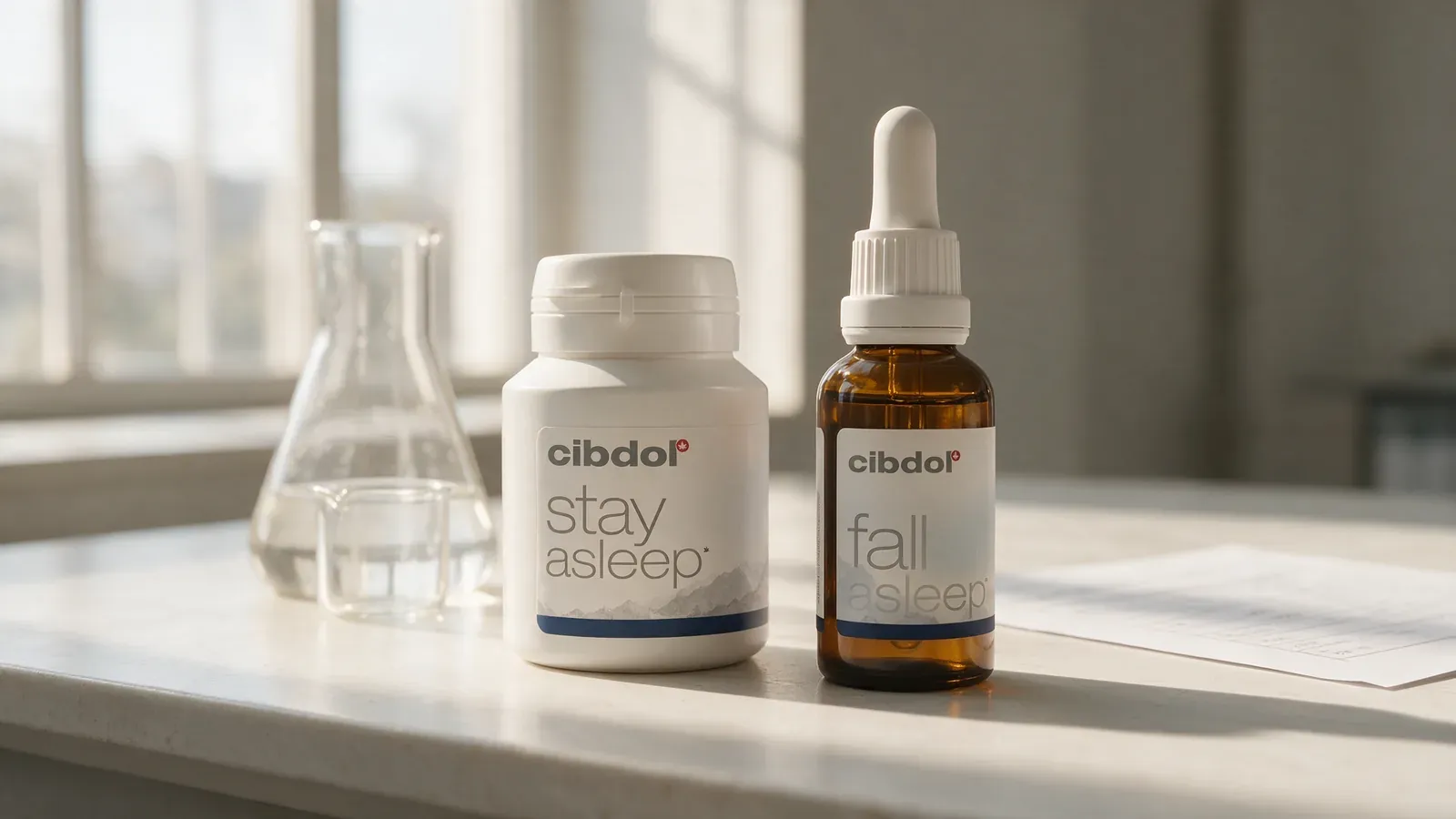
Attempting to target or force a specific proportion of deep sleep is ineffective. Persistent sleep disruption should always be evaluated by a GP rather than addressed with supplements. For those who incorporate botanical formulas into their evening winding-down routine, Cibdol offers several options. Complete Sleep is a 30 ml liquid blending CBN, CBD, chamomile and lavender. Fall Asleep Capsules provide 1.5 mg melatonin and 2.5 mg CBD per capsule across a 30 capsule bottle. Fall Asleep Liquid delivers liposomal melatonin with hemp extract and vitamin B6 in a 30 ml format. Stay Asleep Capsules offer a melatonin-free alternative combining CBD, CBN, hops and griffonia extract in 30 hardcaps. Cibdol also produces CBN Oil 5% + CBD 2.5%, delivering approximately 2 mg CBN and 1 mg CBD per drop in an olive oil base. Every batch undergoes third-party laboratory verification, and none of these products is a medicine.
Frequently Asked Questions
8 questionsWhat are the stages of sleep in order?
How long does a complete sleep cycle last?
What proportion of the night is spent in each sleep stage?
Which stage of sleep is the hardest to wake from?
Why do dreams feel most vivid right before waking?
Why does a wearable tracker show little deep sleep?
Does CBD alter the stages of sleep?
Does CBN increase deep sleep?
About this article

Luke Sholl has been writing about cannabinoids, CBD, and the broader benefits of nature since 2011. His background includes first-hand cannabis cultivation experience spanning the full seed-to-harvest lifecycle across so
This wiki article was drafted with AI assistance and reviewed by Luke Sholl, CBD & wellness writer. Editorial oversight by Joshua Askew.
Medical disclaimer. This content is for informational purposes only and does not constitute medical advice. Consult a qualified healthcare provider before use of any substance.
References (8)
- [1]Patel AK, Reddy V, Shumway KR, Araujo JF (2024). Physiology, Sleep Stages. StatPearls, NCBI Bookshelf. Source
- [2]National Heart, Lung, and Blood Institute (2022). How Sleep Works: Sleep Phases and Stages. Source
- [3]Ohayon MM, Carskadon MA, Guilleminault C, Vitiello MV (2004). Meta-analysis of quantitative sleep parameters from childhood to old age in healthy individuals. Sleep 27(7):1255-1273. Source
- [4]Rasch B, Born J (2013). About sleep's role in memory. Physiological Reviews 93(2):681-766. Source
- [5]Linares IMP, Guimaraes FS, Eckeli A, et al. (2018). No acute effects of cannabidiol on the sleep-wake cycle of healthy subjects: a randomized, double-blind, placebo-controlled, crossover study. Frontiers in Pharmacology 9:315. Source
- [6]Corroon J (2021). Cannabinol and sleep: separating fact from fiction. Cannabis and Cannabinoid Research 6(5):366-371. Source
- [7]Lavender IG, Marshall NS, McCartney D, et al. (2026). Cannabinol for acute treatment of insomnia disorder in a randomized placebo-controlled crossover trial. Journal of Sleep Research. Source
- [8]Hirshkowitz M, Whiton K, Albert SM, et al. (2015). National Sleep Foundation's sleep time duration recommendations: methodology and results summary. Sleep Health 1(1):40-43. Source
Related Articles
Pink noise and the evidence behind coloured sound
A review of acoustic colour definitions, evidence ratings for continuous sound, and laboratory findings on pink noise and sleep structure.
What core sleep means on a wearable device
Core sleep on modern smartwatches corresponds to laboratory light sleep, stages N1 and N2. Earlier research used the term differently, while consumer devices show measurable differences from clinical polysomnography.
Why do we sleep and what the research measures
Researchers have proposed several explanations for sleep, from energy conservation to neural maintenance. This review examines what empirical studies have measured in humans and animals.
Biphasic sleep across history and modern science
This article outlines historical and modern research on biphasic sleep, contrasting preindustrial accounts with field studies and controlled polyphasic trials.
The military sleep method, origins and evidence
The military sleep method traces back to a 1981 book by track coach Bud Winter. Popular retellings claim fast results, but the method itself has not been tested.

Understanding sleep debt and how recovery sleep works
Sleep debt reflects the cumulative difference between required and obtained rest. Laboratory trials reveal how performance deficits accumulate over time and examine the dynamics of subsequent recovery.
How accurate is a sleep tracker at scoring rest stages
Validation studies compare consumer sleep technology with laboratory recordings. Trackers detect sleep reliably but misclassify wakefulness and show inconsistent agreement on stages.

Yoga nidra session steps and scientific evidence
Yoga nidra is a structured guided relaxation practice. Research has evaluated its physiological patterns and measured overnight sleep changes with mixed results.
What objective studies reveal about sleeping positions
Sensor data show adults spend over half the night on their side, with shifts decreasing as age increases. Evidence linking spinal symptoms to specific positions remains thin.
