















What objective studies reveal about sleeping positions
Definition
Objective measurements from accelerometers and cameras describe how adults split the night between postures, how often they turn, and how accurately they remember their sleep.
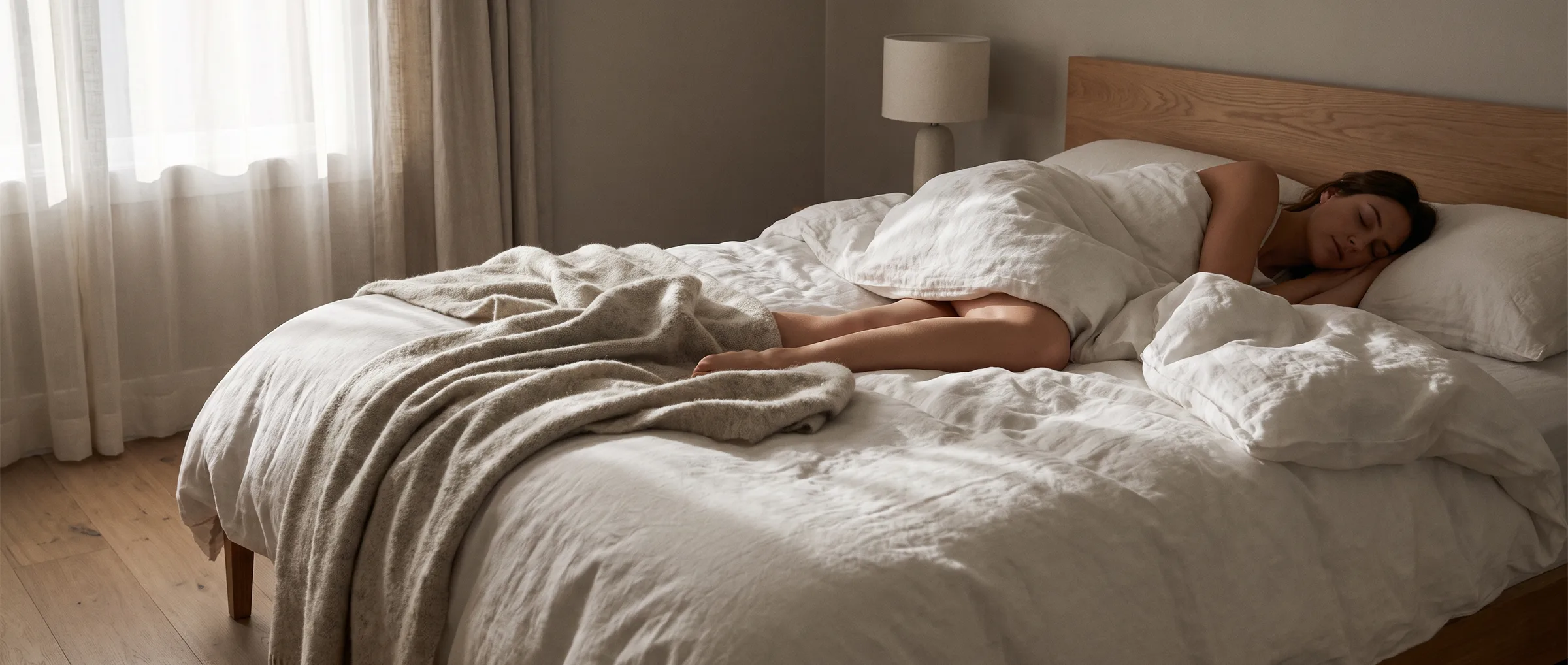
Discussions about sleeping positions often focus on recommendations, yet objective monitoring reveals how adults actually spend the night. Measured rather than recalled, the side comes first. In a Danish working population of 664 adults, 363 men and 301 women, who wore accelerometers on the thigh, upper back and upper arm, time in bed was split on average 54.1 percent on the side, 37.5 percent on the back and 7.3 percent on the front [1].
Age and body size patterns in sleep posture
The distribution of posture is not uniform across all demographics. In the same Danish sample, higher age and higher body-mass index were associated with more time on the side and a proportional reduction in time on the back [1].
A laboratory study that filmed sleepers with a time-lapse camera, one frame every 8 seconds, and scored head, trunk, legs and arms, recorded average position changes of 3.6 per hour at ages 18 to 24, 2.7 at ages 35 to 45 and 2.1 at ages 65 to 80, with 10 people in each group. Across its age groups, lying face down became progressively less common with age, while a preference for the right side grew and was very marked in the oldest group [2].
Frequency of posture changes during the night
Movement during the night varies according to the measurement method used. The Danish participants shifted position on average 1.6 times per hour in bed, and women shifted position less often than men [1].
Position and sleep stage do not appear to be linked. In the same laboratory sample, recorded with polysomnography and time-lapse photography, there was no significant relationship between sleep stage and sleep position in any age group, and no consistent sequence of positions across the night [3]. Posture transitions occur across different stages rather than following a fixed physiological progression.
Accuracy of self-reported posture and waking symptoms
People often have an inaccurate recollection of how they rested. Recalled position can be wrong. In 956 records of people attending a public sleep service for an overnight recording, where position was measured by a sensor and corrected against video where the two disagreed, 93 percent of those who said they had slept on their back were correct, but only 56 percent of those who said they had not slept on their back were correct. Agreement between the reported and measured share of the night spent on the back was only moderate, and people under 55 and women were more likely to under-report back sleeping [4].
When a 2019 scoping review mapped the evidence on sleep posture and waking back or neck complaints, it was thin. Searching the literature up to April 2018, it identified four eligible studies from 4186 articles, all of which measured sleep posture by self-report, one also with infrared cameras. Waking pain and stiffness were the symptoms most often explored, and the authors concluded that there were not enough high-quality studies to answer whether sleep posture and spinal symptoms are related [6].
Physiological differences between the left and right sides
Left and right are not identical. In 130,885 people whose 24-hour heart recordings were made for clinical purposes in Japan, with night-time lying posture classified by accelerometer, heart rate was consistently lowest when lying on the left side and highest when lying on the right side across most age groups. Other heart rate variability measures also differed consistently between the two sides, and the authors describe the posture-related differences as generally small in effect size [5]. The percentages and counts on this page describe what particular samples did in bed. None of them is a recommended position or a target.
Frequently Asked Questions
8 questionsWhich posture accounts for the most time in bed among adults?
Does time spent on the side change with age or body size?
How frequently do people change postures during the night?
Is body posture connected to specific sleep stages?
How accurately do individuals remember whether they rested on their back?
Who is more prone to under-reporting back posture?
What differences appear between resting on the left versus right side?
Does research confirm a connection between sleep posture and morning stiffness?
About this article


Luke Sholl has been writing about cannabinoids, CBD, and the broader benefits of nature since 2011. His background includes first-hand cannabis cultivation experience spanning the full seed-to-harvest lifecycle across so
This wiki article was drafted with AI assistance and reviewed by Luke Sholl, CBD & wellness writer. Editorial oversight by Joshua Askew.
Medical disclaimer. This content is for informational purposes only and does not constitute medical advice. Consult a qualified healthcare provider before use of any substance.
References (6)
- [1]Skarpsno ES, Mork PJ, Nilsen TIL, Holtermann A. Nature and Science of Sleep 2017;9:267-275. doi:10.2147/NSS.S145777, PMID 29138608, PMCID PMC5677378 Source
- [2]De Koninck J, Lorrain D, Gagnon P. Sleep positions and position shifts in five age groups: an ontogenetic picture. Sleep 1992;15(2):143-149. doi:10.1093/sleep/15.2.143, PMID 1579788 Source
- [3]Lorrain D, De Koninck J. Sleep position and sleep stages: evidence of their independence. Sleep 1998;21(4):335-340. doi:10.1093/sleep/21.4.335, PMID 9646377 Source
- [4]Wilson DL, Hollamby M, Skinner T, Hay K, Curtin D, Szollosi I. Misperception of supine sleep in the sleep laboratory: a retrospective review of self-reported versus polysomnography-measured sleep position. Sleep and Breathing 2026;30(1):25. doi:10.1007/s11325-025-03560-4, PMID 41606288 Source
- [5]Yuda E, Hayano J. Sleep posture and autonomic nervous system activity across age and sex in a clinical cohort: analysis of a nationwide ambulatory ECG database. Sensors 2025;25(19):5982. doi:10.3390/s25195982, PMID 41094805, PMCID PMC12526809 Source
- [6]Cary D, Briffa K, McKenna L. Identifying relationships between sleep posture and non-specific spinal symptoms in adults: a scoping review. BMJ Open 2019;9(6):e027633. doi:10.1136/bmjopen-2018-027633, PMID 31256029, PMCID PMC6609073 Source
Related Articles
Pink noise and the evidence behind coloured sound
A review of acoustic colour definitions, evidence ratings for continuous sound, and laboratory findings on pink noise and sleep structure.
What core sleep means on a wearable device
Core sleep on modern smartwatches corresponds to laboratory light sleep, stages N1 and N2. Earlier research used the term differently, while consumer devices show measurable differences from clinical polysomnography.
Why do we sleep and what the research measures
Researchers have proposed several explanations for sleep, from energy conservation to neural maintenance. This review examines what empirical studies have measured in humans and animals.
Biphasic sleep across history and modern science
This article outlines historical and modern research on biphasic sleep, contrasting preindustrial accounts with field studies and controlled polyphasic trials.
The military sleep method, origins and evidence
The military sleep method traces back to a 1981 book by track coach Bud Winter. Popular retellings claim fast results, but the method itself has not been tested.
Understanding sleep debt and how recovery sleep works
Sleep debt reflects the cumulative difference between required and obtained rest. Laboratory trials reveal how performance deficits accumulate over time and examine the dynamics of subsequent recovery.
How accurate is a sleep tracker at scoring rest stages
Validation studies compare consumer sleep technology with laboratory recordings. Trackers detect sleep reliably but misclassify wakefulness and show inconsistent agreement on stages.
Yoga nidra session steps and scientific evidence
Yoga nidra is a structured guided relaxation practice. Research has evaluated its physiological patterns and measured overnight sleep changes with mixed results.
How long can you go without sleep
Documented records describe individuals staying awake for days, but laboratory evaluations show that cognitive lapses and sensory changes begin within the first 24 hours.
