The military sleep method, origins and evidence
Definition
An examination of the military sleep method, its publishing history, retold accounts, and evidence on its separate components.
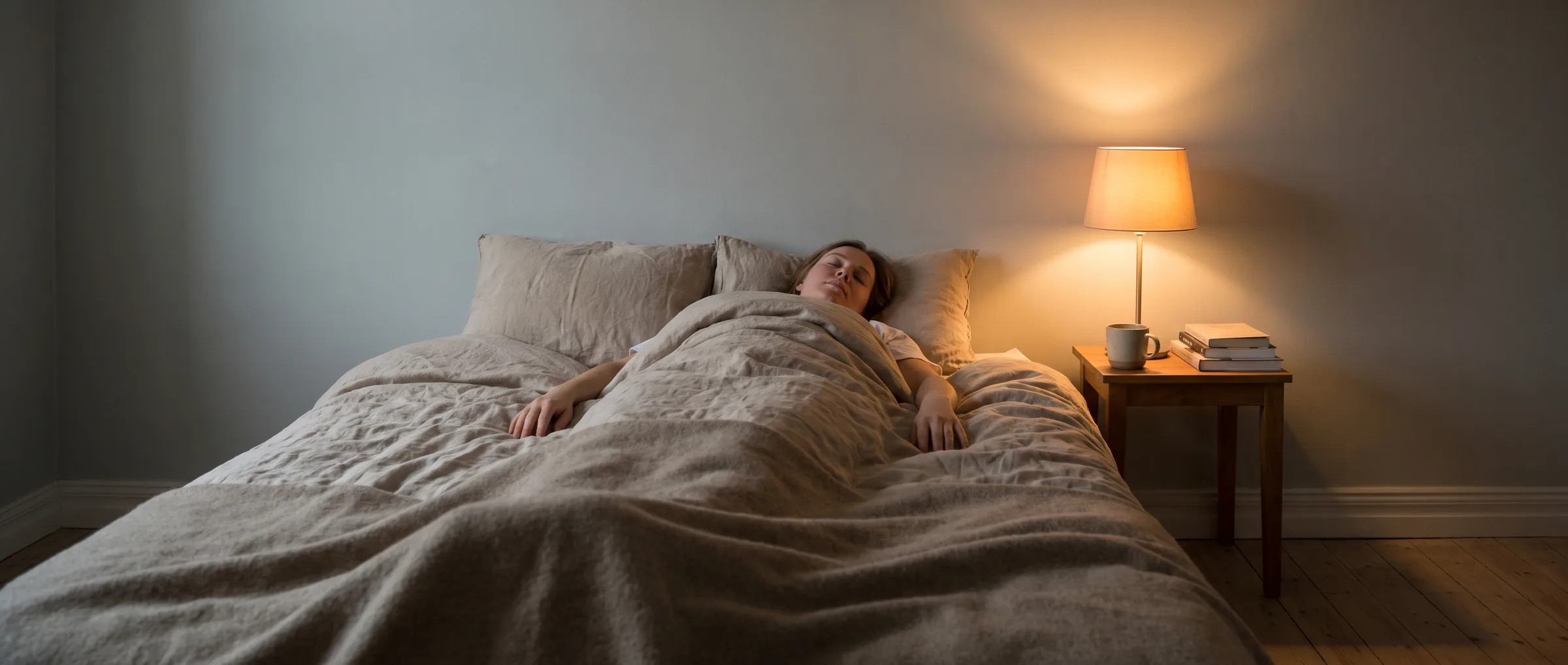
What people call the military sleep method is a sequence of relaxation steps popularised online. This article describes where the military sleep method comes from, how it is retold and what has and has not been tested. It does not prescribe a routine, set a time target for getting to sleep, say that the method helps anyone sleep, or address anyone with a diagnosed condition.
The 1981 book and its author
Relax & Win: Championship Performance in Whatever You Do, by Bud Winter, was published in 1981 by A.S. Barnes in San Diego and Tantivy Press in London, with 273 numbered pages. Its library catalogue subjects are the psychological aspects of sports, stress and relaxation. [1]
USA Track & Field's Hall of Fame biography describes Lloyd "Bud" Winter as a sprint coach who, over a 35-year coaching career, produced 102 All-Americans at San Jose State University, 27 of whom became Olympians. The biography adds that he served as an assistant Olympic coach in 1960 and wrote several coaching manuals. [2]
Retold origins and conflicting details
Popular articles trace the method to Winter's 1981 book. A HuffPost UK article states that Winter said the relaxation technique he helped develop let US Navy trainee airmen get to sleep in 120 seconds during the Second World War, and that in the book Winter said it took six weeks of practice to reach a reported 96 percent success rate. These are claims attributed to the book by a journalist. [3]
The retellings do not agree on the details. A 2023 Big Think article says Winter learned the technique from members of the US Army Air Corps after the Second World War and that pilots at the Pre-Flight School were said to get to sleep within 10 minutes, with 96 percent reportedly doing so after six weeks. A 2024 Cleveland Clinic article says reports conflict about where the method started and whether it is actually taught to military personnel, and that the exact steps vary depending on the source. [4] [5]
The routine as described across sources
As Big Think describes it, the method has five steps: relax the face, drop the shoulders and let the arms go loose, take a slow breath and let the stomach relax, relax the legs, then clear the mind by picturing a calm scene or by repeating the words "don't think" for about 10 seconds. Cleveland Clinic's version groups it into three parts done lying on the back: relaxing each part of the body from the forehead down to the toes, deepening the breath with longer exhales, and imagining a calming place. [4] [5]
No published study has tested the military sleep method as a whole. Cleveland Clinic's 2024 article also states that no studies have been done on the method itself. [5]
Separate tests of relaxation and imagery
Relaxation training of the kind popular retellings link to the method's body-relaxation steps has been tested on its own. In a 1976 study, people who reported difficulty getting to sleep received progressive relaxation training, a placebo procedure or no treatment. All three groups, including the placebo and no-treatment groups, reported significantly shorter times to get to sleep in their daily reports over the course of the study, and the differences between groups were limited to relaxation over no treatment on stage 1 sleep, and relaxation over placebo on questionnaire items and on reported time to sleep at a one-year follow-up. [6]
A 1979 study put 29 people with a sleep complaint through four consecutive sleep laboratory evaluations before and after relaxation training that tensed and then released the muscles, relaxation training without the tensing, or no treatment. The tense-and-release version was significantly more effective than the other two conditions on self-reported sleep measures, and on recorded sleep measures only in the subgroup whose sleep recordings, as the authors classified them, confirmed their reported long time to get to sleep. [7]
A 2026 systematic review and meta-analysis of randomised trials of progressive muscle relaxation pooled 14 studies with 957 adult participants and reported that self-rated sleep quality scores favoured relaxation over control (Hedges g -1.24), with high heterogeneity between studies (I squared 85.5 percent). In adults aged 55 and older the difference was not significant, and the number of relaxation sessions was not significantly associated with the result. [8]
Imagery used to occupy the mind before sleep has been tested on its own. In a 2002 experiment on unwanted thoughts that keep people from getting to sleep, 41 people with a sleep complaint followed one of three instruction sets for one night: distract themselves with an engaging imagery task they had been briefly trained to use, distract themselves in general, or no instructions. Imagery distraction was associated with a shorter time to get to sleep and less frequent and less distressing pre-sleep thoughts than no instructions, while the authors' prediction that general distraction would lengthen the time to sleep and increase unwanted thoughts was not supported. [9]
Status of the two-minute claim
The two-minute figure and the 96 percent success rate come from the book as retold, not from any study cited on this page. The studies above tested relaxation training and imagery on their own, mostly in people who reported difficulty getting to sleep, and none of them tested the complete method or measured a two-minute outcome.
Frequently Asked Questions
8 questionsWhat is the military sleep method?
Who created the technique?
Has the full routine been evaluated in clinical studies?
Is the two-minute time target supported by research?
What do retellings say about its success rate?
How do different media accounts describe the steps?
What did research discover about progressive muscle relaxation?
Did imagery distraction produce measurable changes in trials?
About this article

Luke Sholl has been writing about cannabinoids, CBD, and the broader benefits of nature since 2011. His background includes first-hand cannabis cultivation experience spanning the full seed-to-harvest lifecycle across so
This wiki article was drafted with AI assistance and reviewed by Luke Sholl, CBD & wellness writer. Editorial oversight by Joshua Askew.
Medical disclaimer. This content is for informational purposes only and does not constitute medical advice. Consult a qualified healthcare provider before use of any substance.
References (9)
- [1]Winter B. Relax & Win: Championship Performance in Whatever You Do. San Diego: A.S. Barnes; London: Tantivy Press, 1981. xiv, 273 p. ISBN 0498025411, LCCN 81003639 Source
- [2]USA Track & Field. Lloyd "Bud" Winter, Hall of Fame athlete biography. usatf.org Source
- [3]Glover A. I tried the 'military method' which promises sleep in two minutes. HuffPost UK, Life Source
- [4]Thomson J. The 5-step "military method" for falling asleep in minutes. Big Think, 9 June 2023 Source
- [5]Cleveland Clinic Health Essentials. The military sleep method: does it work? 31 October 2024, with sleep psychologist Alaina Tiani Source
- [6]Borkovec TD, Weerts TC. Effects of progressive relaxation on sleep disturbance: an electroencephalographic evaluation. Psychosomatic Medicine 1976;38(3):173-180. doi:10.1097/00006842-197605000-00003, PMID 778890 Source
- [7]Borkovec TD, Grayson JB, O'Brien GT, Weerts TC. Journal of Applied Behavior Analysis 1979;12(1):37-54. doi:10.1901/jaba.1979.12-37, PMID 381276 Source
- [8]Li K, Chen S, Liu Y, Yu N. The effects of progressive muscle relaxation on sleep quality in adults: a systematic review and meta-analysis of randomized controlled trials. Frontiers in Public Health 2026;14:1906525. doi:10.3389/fpubh.2026.1906525, PMID 42625730 Source
- [9]Harvey AG, Payne S. Behaviour Research and Therapy 2002;40(3):267-277. doi:10.1016/s0005-7967(01)00012-2, PMID 11863237 Source
Related Articles
Pink noise and the evidence behind coloured sound
A review of acoustic colour definitions, evidence ratings for continuous sound, and laboratory findings on pink noise and sleep structure.
What core sleep means on a wearable device
Core sleep on modern smartwatches corresponds to laboratory light sleep, stages N1 and N2. Earlier research used the term differently, while consumer devices show measurable differences from clinical polysomnography.
Why do we sleep and what the research measures
Researchers have proposed several explanations for sleep, from energy conservation to neural maintenance. This review examines what empirical studies have measured in humans and animals.
Biphasic sleep across history and modern science
This article outlines historical and modern research on biphasic sleep, contrasting preindustrial accounts with field studies and controlled polyphasic trials.
Understanding sleep debt and how recovery sleep works
Sleep debt reflects the cumulative difference between required and obtained rest. Laboratory trials reveal how performance deficits accumulate over time and examine the dynamics of subsequent recovery.
How accurate is a sleep tracker at scoring rest stages
Validation studies compare consumer sleep technology with laboratory recordings. Trackers detect sleep reliably but misclassify wakefulness and show inconsistent agreement on stages.
Yoga nidra session steps and scientific evidence
Yoga nidra is a structured guided relaxation practice. Research has evaluated its physiological patterns and measured overnight sleep changes with mixed results.
What objective studies reveal about sleeping positions
Sensor data show adults spend over half the night on their side, with shifts decreasing as age increases. Evidence linking spinal symptoms to specific positions remains thin.
How long can you go without sleep
Documented records describe individuals staying awake for days, but laboratory evaluations show that cognitive lapses and sensory changes begin within the first 24 hours.
