



What clinical trials of sleep meditation actually measured
Definition
Trials examined sleep meditation through structured mindfulness classes and audio exercises, comparing self-reported scores and objective physiological recordings.
In clinical research, sleep meditation refers to structured mindfulness training or guided audio exercises evaluated against specific control conditions. When measured, participants frequently report shifts on rating questionnaires compared to education controls, but meditation did not outperform established sleep treatments. Furthermore, physiological recordings diverge from self-report. This article describes how meditation practices were taught and measured in published studies. It does not prescribe a routine, set a practice target or address anyone with a diagnosed condition.
The clinical course and its structure
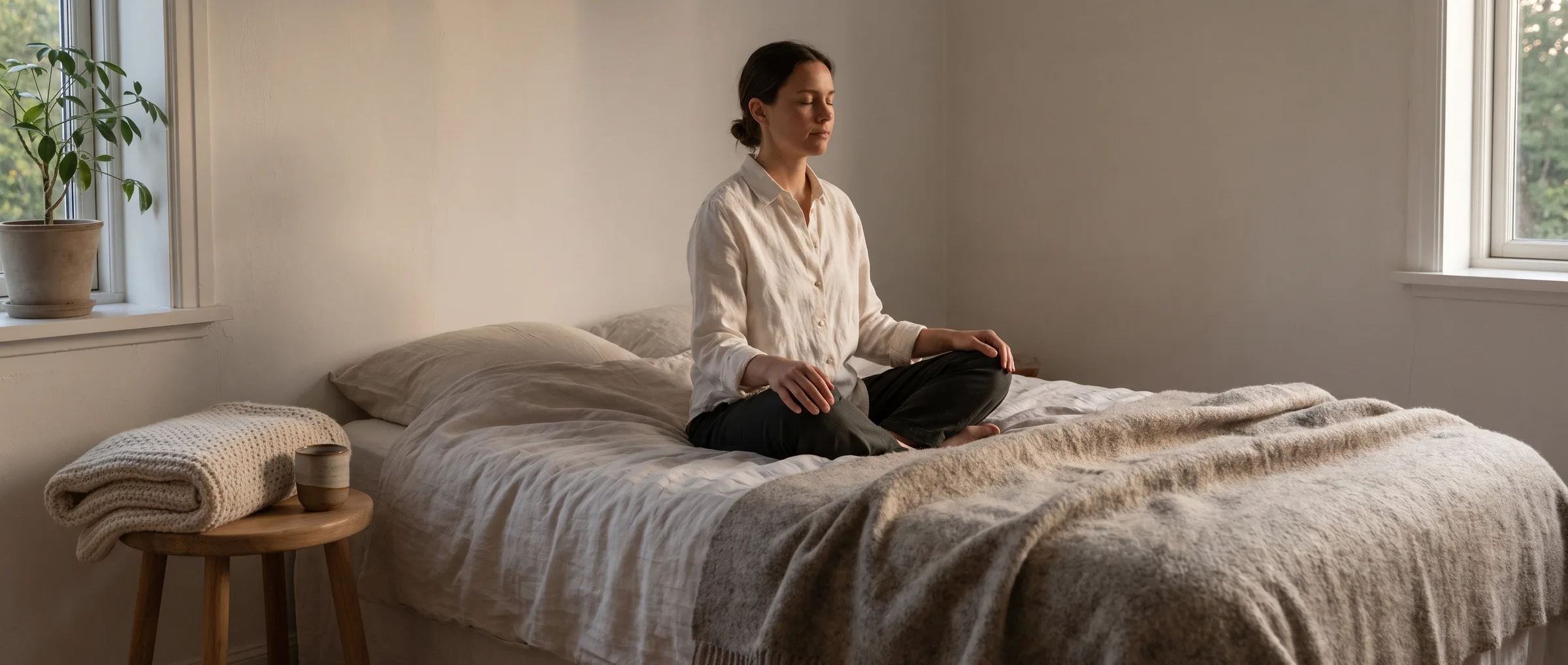
The mindfulness programme in the 2015 trial by Black and colleagues was a group course of 6 weekly sessions of 2 hours, taught by a certified teacher with more than 20 years of mindfulness practice. Its exercises were mindful sitting meditation, mindful eating, appreciation meditation, friendly or loving-kindness meditation, mindful walking and mindful movement, with 10 to 30 minutes of practice in each class. Participants received a book with a guided meditation CD, and daily home practice began at 5 minutes and rose to 20 minutes by the sixth session. [1]
The trial randomised 49 adults aged 55 or over, mean age 66.3, recruited in Los Angeles through a local newspaper advertisement and flyers at a medical research centre and community centres, who scored above 5 on the Pittsburgh Sleep Quality Index. Twenty-four took the mindfulness course and 25 took a sleep hygiene education course that was matched for time, attention, group contact and the expectation of benefit. [1]
Outcomes measured on rating scales
On the Pittsburgh Sleep Quality Index, a 0 to 21 scale, the mindfulness group moved from a mean of 10.2 to 7.4 and the sleep hygiene group from 10.2 to 9.1. The between-group difference was 1.8 points, with a 95 percent confidence interval of 0.6 to 2.9, and an effect size of 0.89, measured immediately after the course. [1]
Fatigue interference and fatigue severity scores differed between the two groups, in the direction of the mindfulness course. Anxiety and perceived stress scores did not differ between the groups. The inflammatory signal NF-kB fell significantly over time in both groups, with no difference between them. [1]
People practised very different amounts. In the mindfulness group the median logged meditation time over the intervention period was 17.2 hours, ranging from 3.7 to 65.3 hours, mean attendance was 4.2 of the 6 sessions, and no adverse events related to the study were reported. [1]
Findings across pooled clinical trials
A systematic review and meta-analysis of 18 randomised trials with 1,654 participants analysed two kinds of comparison separately. Against control conditions matched for time and attention, mindfulness meditation showed a significant difference in sleep quality at the end of treatment, effect size 0.33, and at follow-up, 0.54, rated moderate strength of evidence. Against specific active controls such as evidence-based sleep treatments there was no difference, effect size 0.03 at the end of treatment and -0.14 at follow-up, rated low strength of evidence. [2]
Brief evening sessions before resting
A short bedtime session was tested in one study of university athletes after evening training. The 63 athletes were randomly assigned to watch either a 6-minute mindfulness video just before sleep or a similar 6-minute video without mindfulness content. By questionnaire and sleep diary, the mindfulness group reported lower pre-sleep arousal and higher ratings for level of rest and overall sleep quality, with no difference in sleep duration. [3]
Night recordings and recorded suggestions
In one trial, the recordings did not line up with the questionnaires. In a secondary analysis of a trial in older adults comparing an 8-week mindfulness programme with a sleep hygiene education and exercise programme, 48 and 46 participants gave usable ambulatory polysomnography before and after. Self-reported sleep quality rose in both groups, but stage N2 increased only with mindfulness, stage N3 increased only with the hygiene and exercise programme, and N1, REM and sleep fragmentation showed no significant change over time or between groups. [4]
Recorded suggestions to sleep more deeply, a close relative of guided sleep audio, did not act the same way on every listener. In a sleep laboratory series of five experiments with 70 healthy young women, the 14 highly suggestible women in the main experiment had 81 percent more slow wave sleep during a 90-minute midday nap after a hypnotic suggestion to sleep deeper than after a control tape, while their average self-rated sleep quality did not differ between the two naps. In 15 low-suggestible women the same tape was followed by less slow wave sleep, about two thirds of the amount after the control tape. The authors limit the positive result to young, healthy, suggestible women. When the same suggestion was later presented as guided imagery with a breathing relaxation instead of a hypnotic induction, 21 young healthy low-hypnotizable participants again showed less slow wave sleep in a midday nap afterwards, and their subjective sleep quality was unchanged. [5][6]
Frequently Asked Questions
8 questionsWhat exercises were taught in the six-week mindfulness course?
Who participated in the 2015 mindfulness trial?
How did questionnaire results compare between mindfulness and hygiene education?
Did mindfulness alter stress or inflammation markers in the trial?
How much time did participants spend meditating during the intervention?
How does meditation compare with established clinical treatments in pooled data?
What did overnight laboratory recordings show in older adults?
Do recorded suggestions influence listeners in the same manner?
About this article


Luke Sholl has been writing about cannabinoids, CBD, and the broader benefits of nature since 2011. His background includes first-hand cannabis cultivation experience spanning the full seed-to-harvest lifecycle across so
This wiki article was drafted with AI assistance and reviewed by Luke Sholl, CBD & wellness writer. Editorial oversight by Joshua Askew.
Medical disclaimer. This content is for informational purposes only and does not constitute medical advice. Consult a qualified healthcare provider before use of any substance.
References (7)
- [1]Black DS, O'Reilly GA, Olmstead R, Breen EC, Irwin MR. Mindfulness meditation and improvement in sleep quality and daytime impairment among older adults with sleep disturbances: a randomized clinical trial. JAMA Internal Medicine 2015;175(4):494-501. doi:10.1001/jamainternmed.2014.8081, PMID 25686304, PMCID PMC4407465 Source
- [2]Rusch HL, Rosario M, Levison LM, Olivera A, Livingston WS, Wu T, Gill JM. The effect of mindfulness meditation on sleep quality: a systematic review and meta-analysis of randomized controlled trials. Annals of the New York Academy of Sciences 2019;1445(1):5-16. doi:10.1111/nyas.13996, PMID 30575050 Source
- [3]Li C, Kee YH, Lam LS. Effect of brief mindfulness induction on university athletes' sleep quality following night training. Frontiers in Psychology 2018;9:508. doi:10.3389/fpsyg.2018.00508, PMID 29706914 Source
- [4]Wong KF, Perini F, Lin J, Goldstein M, Ong JL, Lo J, Ong JC, Doshi K, et al. Dissociable changes in sleep architecture with mindfulness and sleep hygiene intervention in older adults: secondary and exploratory analysis of polysomnography data from the Mindfulness Sleep Therapy (MIST) trial. Sleep Health 2022;8(4):364-372. doi:10.1016/j.sleh.2022.02.003, PMID 35484069 Source
- [5]Cordi MJ, Schlarb AA, Rasch B. Deepening sleep by hypnotic suggestion. Sleep 2014;37(6):1143-1152. doi:10.5665/sleep.3778, PMID 24882909 Source
- [6]Cordi MJ, Rasch B. Systematic decrease of slow-wave sleep after a guided imagery designed to deepen sleep in low hypnotizable subjects. Journal of Sleep Research 2021;30(3). doi:10.1111/jsr.13168, PMID 32805770 Source
- [7]Buysse DJ, Reynolds CF, Monk TH, Berman SR, Kupfer DJ. The Pittsburgh Sleep Quality Index: a new instrument for psychiatric practice and research. Psychiatry Research 1989;28(2):193-213. doi:10.1016/0165-1781(89)90047-4, PMID 2748771 Source
Related Articles
Pink noise and the evidence behind coloured sound
A review of acoustic colour definitions, evidence ratings for continuous sound, and laboratory findings on pink noise and sleep structure.
What core sleep means on a wearable device
Core sleep on modern smartwatches corresponds to laboratory light sleep, stages N1 and N2. Earlier research used the term differently, while consumer devices show measurable differences from clinical polysomnography.
Why do we sleep and what the research measures
Researchers have proposed several explanations for sleep, from energy conservation to neural maintenance. This review examines what empirical studies have measured in humans and animals.
Biphasic sleep across history and modern science
This article outlines historical and modern research on biphasic sleep, contrasting preindustrial accounts with field studies and controlled polyphasic trials.
The military sleep method, origins and evidence
The military sleep method traces back to a 1981 book by track coach Bud Winter. Popular retellings claim fast results, but the method itself has not been tested.

Understanding sleep debt and how recovery sleep works
Sleep debt reflects the cumulative difference between required and obtained rest. Laboratory trials reveal how performance deficits accumulate over time and examine the dynamics of subsequent recovery.
How accurate is a sleep tracker at scoring rest stages
Validation studies compare consumer sleep technology with laboratory recordings. Trackers detect sleep reliably but misclassify wakefulness and show inconsistent agreement on stages.
Yoga nidra session steps and scientific evidence
Yoga nidra is a structured guided relaxation practice. Research has evaluated its physiological patterns and measured overnight sleep changes with mixed results.
What objective studies reveal about sleeping positions
Sensor data show adults spend over half the night on their side, with shifts decreasing as age increases. Evidence linking spinal symptoms to specific positions remains thin.
