Lavender: One Genus, One Oil, One Famous Molecule
Definition
Lavender is the common name for a group of woody, aromatic sub-shrubs in the genus Lavandula, part of the mint family. Its oil is distilled from the flower spikes, and an analysis of that oil names a short list of terpene molecules in shifting proportions, linalool among them. The same molecule turns up in hemp, which is where lavender enters cannabinoid conversations.
One word, a whole genus
How many plants hide behind the word lavender? More than a bunch of dried stems on a market stall would suggest. Lavender is the common name for a group of woody sub-shrubs in the genus Lavandula, and that genus belongs to the mint family. Botanically, then, the plant keeps company with rosemary, sage, thyme, oregano and basil. You can see the family resemblance without a microscope: squarish stems, leaves set in opposite pairs, and aromatic oil held in small surface glands rather than buried in the wood.
The growth habit is easy to read. A low, branching base that goes grey and woody as the plant ages. Narrow leaves in a dusty grey-green. Flower spikes carried above the foliage on bare stalks. Most of the oil sits in and around those spikes, which is why harvest means cutting the flowering tops and leaving the bush in the ground for the next season.
Then comes the part that catches people out. Lavender is not one species but several, plus hybrids, and they do not analyse the same. Spike lavender, Lavandula latifolia, is the clearest example. Its oil comes back from the laboratory with a higher share of camphor and 1,8-cineole, and a lower ester content, than the material sold simply as lavender oil. Same common name in casual speech. Different numbers on the certificate.
That is the practical reason botanists insist on Latin. A Latin binomial fixes which plant was cut, which means the analysis attached to it can be compared with another analysis. A trade name fixes almost nothing. Anyone who has bought two bottles labelled lavender and found them behaving differently in a formulation has met this problem already. It is not mystery. It is species, cultivar and growing conditions, written down or not written down.
- Family first. Lavandula sits in the mint family, alongside a long list of culinary herbs that also store volatile oil in surface glands.
- A shrub, not a soft herb. The base is woody and perennial, and the flowering stems are the part that carries the oil worth distilling.
- Lavandula latifolia is its own case. Known as spike lavender, it shows more camphor and 1,8-cineole and a lower ester share than standard lavender material.
- Hybrids exist and are grown at scale. Crosses within the genus, cultivated commercially as lavandin, are a separate line of material again and should be read under their own name.
- Cut the spikes. Because the oil glands cluster on the flowering tops, harvest timing sits close to the chemistry of the finished distillate.
- Latin beats marketing. A species name plus a batch analysis tells you what you have; the word lavender on its own does not.
Steam, flower heads and a list of names
Lavender oil is not lavender. It is a fraction of it. Steam runs through the cut flowering tops, carries the volatile compounds with it, and the condensed mixture separates into water and a thin layer of oil. Everything that will not travel with steam stays in the still: the fibre, the pigments, the water-soluble material. What you end up with is a concentrated set of small, light molecules, and the yield from a heap of plant material is modest.
Run that oil through a gas chromatograph and you get a list. Two names usually head it: linalool, a monoterpene alcohol, and linalyl acetate, which is the ester formed from linalool and acetic acid. Terpene chemistry is tidy that way. An alcohol and its acetate are close relatives, and the ratio between them is one of the numbers analysts watch.
Below that pair, the same handful of names keeps appearing in lavender oil analyses, in proportions that vary from sample to sample: camphor, borneol, 1,8-cineole, terpinen-4-ol, lavandulyl acetate, ocimene and beta-caryophyllene. Each belongs to a chemical class, and the classes are worth knowing because they explain why the list is stable while the percentages are not. Camphor is a ketone. Borneol and terpinen-4-ol are alcohols. 1,8-cineole is an oxide, sometimes written as eucalyptol in older literature. Lavandulyl acetate is a second ester in the profile. Ocimene is a straight-chain terpene hydrocarbon with no ring at all. Beta-caryophyllene is the odd one out by size: a sesquiterpene, built from fifteen carbon atoms rather than the ten that make up a monoterpene, which makes it heavier and slower to evaporate.
Why do the proportions move? Because a distillate records the growing season as much as the species. Cultivar, altitude, soil, the weather in the weeks before harvest, the day the field was cut, how long the still ran and which part of the run was collected all leave a mark on the final ratios. Spike lavender demonstrates the point at species level with its higher camphor and 1,8-cineole and lower ester content, but the same drift happens within a single species, field by field and year by year.
This is exactly why anyone working with botanical material asks for the analysis rather than the adjective. A number for the ester share, a number for camphor, a species name at the top of the page. That is a document you can compare. A description on a front label is not. Since 2014 our own working standard has been the same on the hemp side: know what is in the bottle, batch by batch, and publish it.
Reading a lavender oil report, point by point
- Find the species. Look for the Latin binomial before anything else. Lavandula latifolia on the page means spike lavender, and that carries an expectation of more camphor and 1,8-cineole and less ester than generic lavender material.
- Check what was distilled. The oil comes from the flowering tops, where the glands sit. A report that names the plant part tells you the material was handled with the chemistry in mind.
- Note the extraction route. Steam distillation captures the volatile fraction and leaves the rest in the still, so the profile you are reading is a subset of the plant, not the whole plant.
- Read the two lead compounds. Linalool and linalyl acetate usually sit at the top of a lavender analysis, and the ratio between an alcohol and its acetate is one of the routine markers analysts compare between batches.
- Look at the ester line. Esters in this profile include linalyl acetate and lavandulyl acetate. A low total ester figure is a real distinguishing feature rather than a fault, and it is characteristic of spike lavender.
- Look at camphor and 1,8-cineole together. These two rise as a pair in Lavandula latifolia material, which is the single clearest chemical signature separating it from its relatives.
- Scan the alcohols. Borneol and terpinen-4-ol appear regularly in lavender oil analyses in variable amounts, and both are monoterpene alcohols, chemically not far from linalool itself.
- Find the hydrocarbon. Ocimene is a straight-chain monoterpene with no ring, and it belongs to the standard cast of a lavender profile even when the percentage is small.
- Spot the sesquiterpene. Beta-caryophyllene is bigger than the rest at fifteen carbons, which is why it is grouped separately from the ten-carbon monoterpenes on a well-organised report.
- Accept the variability. The list of names in lavender oil is fairly consistent; the proportions are not, and any analysis is a snapshot of one batch from one harvest.
- Compare like with like. Two reports are only worth setting side by side when both state the species, the plant part and the method, which is the whole argument for keeping documentation with the material.
Names, categories and dates in one overview
| Entry | Category | What the record states | Where it comes up |
|---|---|---|---|
| Lavandula latifolia | Species within the genus | Known as spike lavender; higher camphor and 1,8-cineole, lower ester content | Botanical naming and oil specification |
| Linalool | Monoterpene alcohol | One of the two names that head a typical lavender oil analysis | Oil analysis; also listed in hemp terpene profiles |
| Linalyl acetate | Ester of linalool | The acetate partner of linalool; part of the ester total on a report | Oil analysis, ratio comparisons between batches |
| Camphor | Ketone | Named in lavender oil analyses in variable proportions; elevated in spike lavender | Species differentiation |
| Borneol | Monoterpene alcohol | Listed among lavender oil constituents, proportion varies by batch | Oil analysis |
| 1,8-cineole | Monoterpene oxide | Named in lavender oil analyses; elevated in Lavandula latifolia | Species differentiation |
| Terpinen-4-ol | Monoterpene alcohol | Part of the standard constituent list, in variable proportions | Oil analysis |
| Lavandulyl acetate | Ester | A second acetate named alongside linalyl acetate in lavender oil | Ester total on a report |
| Ocimene | Acyclic monoterpene hydrocarbon | Listed as a lavender oil constituent, proportion not fixed | Oil analysis |
| Beta-caryophyllene | Sesquiterpene | Fifteen carbons rather than ten; named among lavender oil constituents | Oil analysis; also common in hemp terpene profiles |
| Eau de cologne | Perfumery structure | Lavender documented as an anchor within the composition | Classical fragrance construction |
| Fougere accord | Fragrance family | Built on three pillars: lavender, coumarin and a mossy-woody base | Perfumery classification |
| Houbigant, 1882 | Origin point | Fougere Royale recorded as the origin of the fougere accord | Fragrance history |
| Masculine fragrance | Market segment | The fougere structure remains the base of a large share of it | Ongoing commercial use of lavender |
| Russo (2011) | Review article | Discusses cannabis terpenes together with cannabinoids and the character of a whole-plant extract, under the label entourage effect [1] | Cannabinoid literature |
| Status of that proposal | Evidence level | Framed as a hypothesis and a research agenda rather than a settled conclusion [1] | How the 2011 review frames it |
Where lavender meets hemp
Linalool is the reason this page exists in a cannabinoid context at all. It is not a lavender molecule in any exclusive sense. Plants that share no close family tie build the same terpenes, because the biochemical route to them is old and widespread, and linalool is one of the compounds that shows up on both a lavender oil analysis and a hemp terpene profile. Beta-caryophyllene does the same thing, appearing in the lavender constituent list and in hemp analyses alike. The plants are unrelated. The molecules are identical.
That overlap is what the 2011 review by Russo works with. It sets cannabis terpenes next to cannabinoids and asks whether the combined composition explains the character of a whole-plant extract compared with an isolated compound, applying the concept of the entourage effect [1]. Worth being clear about the status. Russo presents it as a hypothesis and a research agenda, not as a demonstrated conclusion [1]. We think saying so plainly is more useful than borrowing the term as a slogan.
Meanwhile, lavender has a documented working life that has nothing to do with cannabinoids. It has served as an anchor inside eau de cologne compositions, and it is one of three pillars of the fougere accord, together with coumarin and a mossy-woody base. That accord has a birth date: Houbigant's Fougere Royale, 1882. More than a century later it remains the structure under a large share of masculine fragrance. Not a curiosity. A load-bearing part of the industry.
- The species name is the first useful fact. If a report says Lavandula latifolia, expect the camphor and 1,8-cineole to sit higher and the esters lower, because that is the recorded signature of spike lavender.
- Shared molecules are not shared plants. Linalool and beta-caryophyllene appear in both lavender oil and hemp analyses, which tells you about biochemistry rather than about botanical relatedness.
- Read the entourage effect as an open question. Russo's 2011 review applies the idea and argues it deserves study, framing it as a hypothesis rather than a settled conclusion [1].
- Percentages travel with the batch. Because the proportions in a distillate shift with harvest and distillation, the only number worth trusting is the one measured on the material in front of you.
- Categories help you read a list. Sorting constituents into alcohols, esters, a ketone, an oxide, a hydrocarbon and a sesquiterpene turns a wall of names into something you can actually compare across reports.
- Documentation is the whole point. Working with cannabinoids since 2014 has taught us the same lesson botanical suppliers learned long before: publish the analysis, and let the reader check it.
Inhaled essential oils and sleep research
A systematic review examined the effect of inhaled essential oils on sleep and assessed the quality of the studies it found, which is a stronger starting point than any single aromatherapy trial. [2] Rather than relying on isolated publications or uncontrolled accounts, this systematic evaluation compiled investigations where participants were exposed to aromatic plant oils during the night. Lavender appeared as the most frequently tested botanical in the gathered literature. The analysis brought together findings across diverse settings, providing a structured overview of whether inhaling aromatic volatiles produced measurable changes in nighttime rest.
Assessing the design of inhalation trials
That review's contribution is as much about the state of the evidence as about the result: it set out how the available studies were designed and where they were weak. [2] The review pointed to small sample sizes, weak methods and weak endpoints. By detailing these design differences, the authors noted that while modest positive patterns appeared across several papers, the overall certainty of the literature remains constrained by these weaknesses.
Inhalation versus oral administration
The reviewed evidence concerns inhalation. A lavender extract taken by mouth in a supplement is a different route and is not what those studies measured. Inhaling aromatic volatiles delivers airborne terpenes through the nasal passages, where they interact with olfactory receptors and enter circulation via the respiratory tract. In contrast, an ingested extract passes through the stomach and intestines before undergoing metabolism in the liver. This distinct biological journey changes compound bioavailability, absorption rates, and systemic distribution.
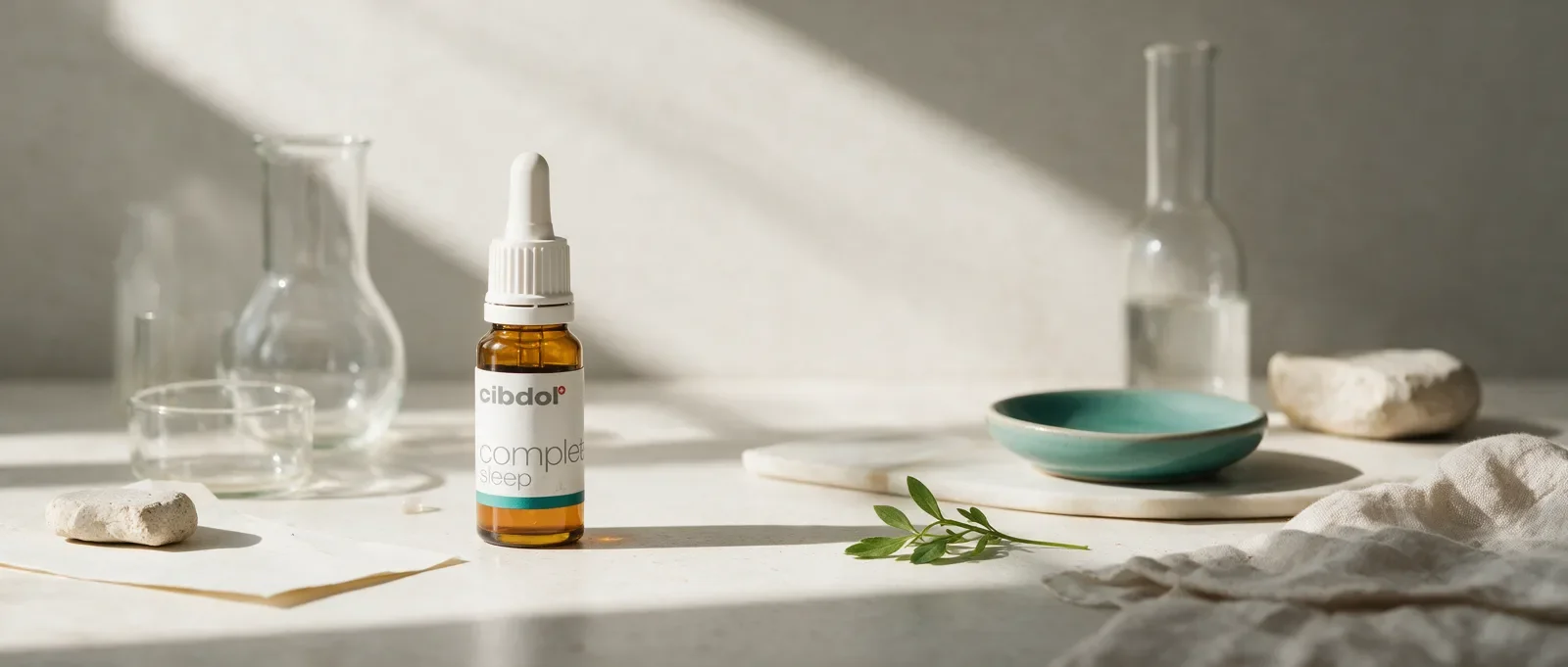
Cibdol uses lavender extract in Complete Sleep, taken by mouth as a liquid, alongside chamomile extract, CBD and CBN. Formulations of this type rely on ingestion rather than dispersed scent. This article reports a systematic review and marks the difference between inhaling a scent and swallowing an extract. It is not medical advice.
Frequently Asked Questions
8 questionsIs spike lavender the same thing as lavender?
Which molecules does a lavender oil analysis actually name?
Is the linalool in hemp the same as the linalool in lavender?
What does the entourage effect have to do with lavender?
What did the systematic review on inhaled essential oils examine?
Why were the inhalation studies considered methodologically weak?
Does inhaling lavender essential oil work the same way as swallowing it?
Which compounds are combined with lavender extract in Complete Sleep?
About this article


Luke Sholl has been writing about cannabinoids, CBD, and the broader benefits of nature since 2011. His background includes first-hand cannabis cultivation experience spanning the full seed-to-harvest lifecycle across so
This wiki article was drafted with AI assistance and reviewed by Luke Sholl, CBD & wellness writer. Editorial oversight by Joshua Askew.
Medical disclaimer. This content is for informational purposes only and does not constitute medical advice. Consult a qualified healthcare provider before use of any substance.
Last reviewed August 26, 2026
References (2)
- [1]Russo (2011). Taming THC: potential cannabis synergy and phytocannabinoid-terpenoid entourage effects.
- [2]Lillehei AS, Halcon LL. A systematic review of the effect of inhaled essential oils on sleep. Journal of Alternative and Complementary Medicine 2014;20(6):441-451. doi:10.1089/acm.2013.0311 Source
Related Articles
Valencene: The Molecule Behind the Name
A sesquiterpene built from three isoprene units, fifteen carbons in total, formula C15H24. Here is what the chemistry fixes, and where the published record runs out.
Terpineol: Lilac, Not Pine
Hemp aroma gets talked about in pine and citrus. Terpineol sits somewhere else: a floral monoterpene alcohol whose name hides four isomers and whose boiling point is reported inconsistently.
Sabinene Explained: Formula, Family, Boiling Point
Sabinene sits in the terpene family, with the formula C10H16 and a molar mass around 136 g/mol. Here is what the chemistry fixes, and where the record for this single molecule stops.
Phytol: From Chlorophyll to a Boiling Point
A terpenoid with an alcohol group, a diterpene backbone, and a boiling point that only makes sense with its pressure condition attached. Here is what the record holds, and where it stops.
Ocimene, Described in Four Lines
A short, precise look at one aromatic molecule: its family in the terpene group, the four words used for its smell, and what the approximate 100 °C figure actually marks.
Guaiol: 15 Carbons, One Hydroxyl Group, Two Boiling Points
Guaiol is a sesquiterpene alcohol: a 15-carbon skeleton carrying a hydroxyl group. Here is its structure, its aroma profile, and why one molecule ends up with two very different boiling point figures.
Geraniol: Formula, Family, Boiling Point
Geraniol is a monoterpene alcohol with the formula C10H18O and a boiling point near 230 °C at atmospheric pressure. Here is what the chemistry pins down, and where the published record still opens out.
What Is Farnesene? Start With the Formula
Farnesene is a C15H24 hydrocarbon, and the name covers a family of isomers rather than a single compound. Here is the chemistry, the difference from farnesol, and what the plant record says.
Eucalyptol on a Lab Report: One Compound, Two Names
Eucalyptol and 1,8-cineole are the same molecule written two ways. Here are the terpene basics, the number that keeps getting quoted, and why the batch document matters more than the spelling.
