Borneol: A Terpene, Read From Its Formula
Definition
Borneol is a bicyclic monoterpene alcohol with the formula C10H18O: ten carbon atoms closed into two fused rings, plus one OH group. It belongs to the terpenes, the aromatic compounds plants produce, and published figures put its boiling point at around 213 °C at ordinary atmospheric pressure. In the 2011 review by Russo it is recorded as a widely occurring compound rather than a rarity [1].
A snapped sprig on a walk
One second, one molecule
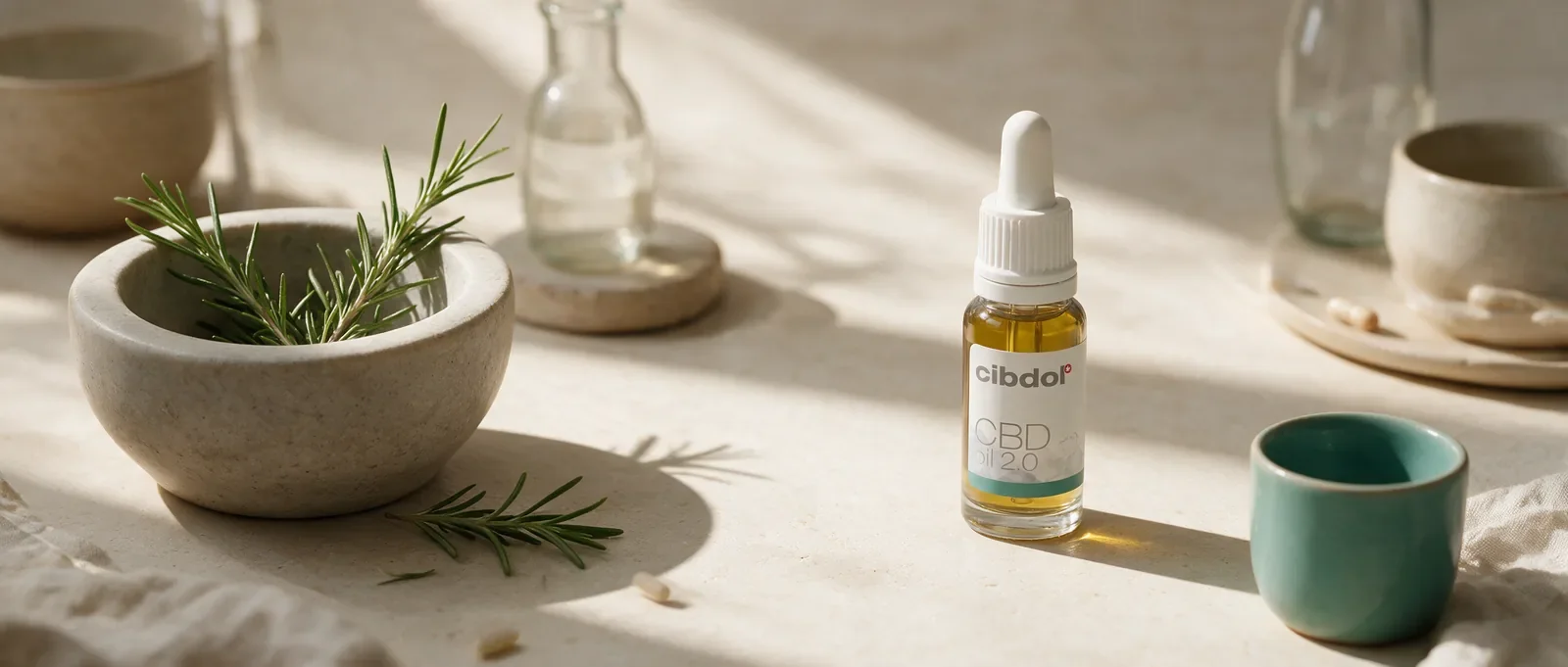
You pinch a rosemary sprig between two fingers on a walk and keep going. Within a second, the air around your hand has changed. Nothing was heated, nothing was extracted, nothing was pressed. Volatile molecules left the crushed leaf on their own and reached your nose, which is what volatile means: light enough to travel through air at ordinary temperatures. One of the molecules doing that job has a name, a formula, and a line in our documentation.
The family it belongs to
Aromatic plant compounds of this kind are grouped together as terpenes. Rosemary, pine, citrus peel and hemp all make them, and each of them makes several at once. Borneol is common enough to have its own entry in the Cibdol terpene chart. That entry is kept narrow on purpose. It records what the molecule smells like and how the molecule is built, and it stops there. Since 2014 that has been the working habit here: write down what can be checked, and leave the rest open.
The molecule, written out
Borneol is a bicyclic monoterpene alcohol. Three words, and each one carries information. Monoterpene tells you the size: ten carbon atoms, the standard frame for this class of plant compounds. Bicyclic tells you the shape: those carbons close into two rings sharing a bridge, so the skeleton sits as a compact cage instead of a loose chain. Alcohol tells you what is attached: an oxygen carrying a hydrogen, the group written as OH. Put the atoms in order and you get C10H18O. Ten carbons. Eighteen hydrogens. One oxygen. That oxygen is what separates an alcohol like this one from the terpenes built out of carbon and hydrogen alone, and it is also why the name ends the way it does. Chemical names are not decoration. Read one slowly and it describes the object. Borneol's name describes a caged ten-carbon molecule wearing a single OH group.
Heat, pressure, and one number
Around 213 °C, with the small print
Published figures for borneol's boiling point cluster around 213 °C at ordinary atmospheric pressure. That second half of the sentence is not filler. Boiling points shift with pressure, so a temperature quoted without its pressure is half an answer. At normal pressure, then, 213 °C is roughly where the liquid turns to vapour in bulk.
What the figure covers
One number, one question answered. It marks bulk boiling. It says nothing about how much of the compound drifts out of a leaf at room temperature, which is a separate measurement, and it says nothing about what happens in a body. A physical constant describes the substance and stops there. There is also the matter of company. Borneol rarely turns up alone: in a leaf, in a resin, in an extract, it sits alongside dozens of other molecules, each with its own set of numbers. Read on its own, a boiling point is a data point rather than a picture.
Common, in plain terms
Borneol is not an exotic find. In the 2011 review by Russo it is recorded as a widely occurring compound rather than a rarity [1], which is the ordinary situation for terpenes. The same molecule shows up in plants that share no close botanical relationship, because unrelated species can run the same chemistry. Whether that surprises you probably depends on how the word terpene reached you first, through cannabis or through a herb garden. Either way, it has a practical consequence for anyone reading an aroma note: a familiar smell in the air points to a molecule, not to a species.
- Class: terpenes, the aromatic compounds plants produce.
- Identity: a bicyclic monoterpene alcohol, so two fused rings plus an OH group.
- Formula: C10H18O, ten carbons, eighteen hydrogens, one oxygen.
- Boiling point: around 213 °C at ordinary atmospheric pressure.
- Occurrence: widespread across plants rather than rare [1].
- Our chart entry: smell and structure, and nothing past those two.
The 2011 review, and its edges
The reason a molecule like borneol appears in cannabis literature at all runs through one paper: Russo, 2011 [1]. Its subject is the possibility that terpenes and cannabinoids do something together when they sit in the same plant material, an idea usually shortened to the entourage effect. Worth being exact about the kind of document that is. It gathers existing work and argues a case. It is a proposal on the record, not a trial that measured a named outcome in people, and the paper itself is clear about how much stays open [1].
- Documented: borneol's identity, formula and boiling point, all standard chemistry.
- Documented: its wide occurrence across plant species, as recorded in the 2011 review [1].
- Proposed: an interaction between terpenes and cannabinoids in the same material [1].
- Not established: any outcome in humans attributable to borneol by itself.
- Not on our chart: anything past smell descriptors and structure.
- Open: how far a proposal from 2011 can be carried into practice.
From the chart to the bottle
Where the entry lives
Borneol keeps its own line in the Cibdol terpene chart, and that line holds two things: how it smells and how it is built. If you want the short version of what a terpene is before you start looking up individual names, the chart is where we send people, because it handles each compound as a molecule with a profile instead of a promise. Terpenes sit next to the cannabinoids in the same conversation, which is why that chart exists in the first place.
Browsing the range by format
If you arrived here with a product question rather than a chemistry one, the Cibdol range is organised by format, and the oils are grouped together as CBD oil 2.0. That is a sensible place to start if you would rather compare formats side by side before reading further into single compounds. Every batch is analysed independently, so what is printed on the label can be checked against a report. Working with cannabinoids since 2014, that is the part we would rather be judged on than any adjective.
Frequently Asked Questions
4 questionsWhich class of plant compounds does borneol belong to?
What does the formula C10H18O actually tell you?
Why is the pressure always quoted next to the 213 °C figure?
What did the 2011 review by Russo put forward?
About this article


Luke Sholl has been writing about cannabinoids, CBD, and the broader benefits of nature since 2011. His background includes first-hand cannabis cultivation experience spanning the full seed-to-harvest lifecycle across so
This wiki article was drafted with AI assistance and reviewed by Luke Sholl, CBD & wellness writer. Editorial oversight by Joshua Askew.
Medical disclaimer. This content is for informational purposes only and does not constitute medical advice. Consult a qualified healthcare provider before use of any substance.
Last reviewed August 29, 2026
References (1)
- [1]Russo, E.B. (2011). Taming THC: potential cannabis synergy and phytocannabinoid-terpenoid entourage effects. DOI: https://doi.org/10.1111/j.1476-5381.2011.01238.x
Related Articles
Valencene: The Molecule Behind the Name
A sesquiterpene built from three isoprene units, fifteen carbons in total, formula C15H24. Here is what the chemistry fixes, and where the published record runs out.
Terpineol: Lilac, Not Pine
Hemp aroma gets talked about in pine and citrus. Terpineol sits somewhere else: a floral monoterpene alcohol whose name hides four isomers and whose boiling point is reported inconsistently.
Sabinene Explained: Formula, Family, Boiling Point
Sabinene sits in the terpene family, with the formula C10H16 and a molar mass around 136 g/mol. Here is what the chemistry fixes, and where the record for this single molecule stops.
Phytol: From Chlorophyll to a Boiling Point
A terpenoid with an alcohol group, a diterpene backbone, and a boiling point that only makes sense with its pressure condition attached. Here is what the record holds, and where it stops.
Ocimene, Described in Four Lines
A short, precise look at one aromatic molecule: its family in the terpene group, the four words used for its smell, and what the approximate 100 °C figure actually marks.
Guaiol: 15 Carbons, One Hydroxyl Group, Two Boiling Points
Guaiol is a sesquiterpene alcohol: a 15-carbon skeleton carrying a hydroxyl group. Here is its structure, its aroma profile, and why one molecule ends up with two very different boiling point figures.
Geraniol: Formula, Family, Boiling Point
Geraniol is a monoterpene alcohol with the formula C10H18O and a boiling point near 230 °C at atmospheric pressure. Here is what the chemistry pins down, and where the published record still opens out.
What Is Farnesene? Start With the Formula
Farnesene is a C15H24 hydrocarbon, and the name covers a family of isomers rather than a single compound. Here is the chemistry, the difference from farnesol, and what the plant record says.
Eucalyptol on a Lab Report: One Compound, Two Names
Eucalyptol and 1,8-cineole are the same molecule written two ways. Here are the terpene basics, the number that keeps getting quoted, and why the batch document matters more than the spelling.
