Inside the Plant: How Cannabinoids Get Built

Definition
Cannabinoid building in hemp is enzyme work: named proteins take one molecule and hand back another, in a fixed order, inside the plant's own resin tissue. Two publications carry most of what is solidly known, from 1996 and 2012. Both describe characterised proteins in Cannabis sativa, not vague plant processes.
A jar, a loupe, and a fair question
What the light shows
Late evening, kitchen table. A jar of hemp flower sits under a phone torch held at an angle, and the surface looks frosted. Borrow a cheap loupe and the frost resolves into hundreds of small stalks with glassy heads. That is as close as the eye gets. Nobody has ever watched a cannabinoid being assembled. Everything we can say about the building work comes from proteins that have been isolated, named and measured, and it is worth holding that distinction before any chemistry starts.
Proteins with names and dates
Two publications carry most of this page. In 1996, Taura, Morimoto and Shoyama purified and described cannabidiolic-acid synthase from Cannabis sativa [2]. In 2012, Gagne and colleagues identified olivetolic acid cyclase in the same species [1]. Both are enzymes, which means proteins that take one molecule and hand back another in a fixed, repeatable way. Neither paper describes a plant with intentions. They describe characterised proteins doing measurable chemistry, and that is the only kind of statement worth building on. Names, years, species: those three things separate a pathway from a story.
From olivetolic acid to CBGA
One arrow, two molecules. Olivetolic acid goes in, CBGA comes out [1]. Chemists spent a long time on that arrow, because olivetolic acid has to be built and its ring closed before anything recognisably cannabinoid exists in the plant at all. The 2012 study by Gagne and colleagues identified the enzyme responsible for that ring closure, olivetolic acid cyclase, working in Cannabis sativa [1]. A cyclase is a ring-maker: it takes a chain and joins it into a closed loop. Once CBGA exists, the route can branch toward the individual acids that lab reports later list by name.
Why the 2012 route was noteworthy
Polyketides are a large family of plant compounds built by stacking small carbon units, like beads on a thread, then folding the result. Plants make thousands of them, and the enzymes involved follow fairly familiar patterns. The catalytic route described for Cannabis sativa in 2012 does not follow those patterns closely, which is what makes it unusual among plant polyketides [1]. Hemp, in other words, arrives at its starting cannabinoid by a route of its own.
The pathway as a numbered sequence
- Everything the living plant assembles along this route carries an acid group. The A in CBGA and CBDA is part of the chemistry, not a typographical quirk on an analysis.
- Olivetolic acid sits at the front of the section covered by the 2012 work, and the ring-closing enzyme that acts on it was identified in Cannabis sativa [1].
- CBGA is the product of that step [1]. From there, the route divides toward the separate acids that give a cultivar its profile.
- Cannabidiolic-acid synthase is the protein named for one of those branches. It was purified from Cannabis sativa and characterised in 1996 [2].
- The finished acids are not transported [2]. Whatever the tissue builds, the tissue keeps, which is why the resin heads on that flower matter more than the leaf around them.
- Each step above has a protein behind it, with a species, a year and a method attached. That is the standard we read this topic by, and it rules out a lot of confident-sounding material found elsewhere.
What the two papers establish, and what they leave open
- Taura, Morimoto and Shoyama, 1996: cannabidiolic-acid synthase purified and characterised from Cannabis sativa [2]. Purified means separated from everything else in the tissue, so the activity measured belongs to that protein and nothing hiding beside it.
- Gagne and colleagues, 2012: olivetolic acid cyclase identified in Cannabis sativa, with olivetolic acid converted onward to CBGA [1].
- The 2012 paper also places that chemistry in context, describing the catalytic route as unusual among plant polyketides [1]. It is a statement about how, not about how much.
- On the movement question, the 1996 record is plain: no transport of the finished acids [2].
- Neither paper puts a figure on what a particular crop yields, and neither concerns itself with what any preparation does in a person. Both are laboratory studies of characterised proteins.
- Read together, they cover a defined stretch of the route. Other steps and other synthases exist in the wider literature, and we would rather name the two we can cite precisely than gesture at all of it.
Where this meets a batch report
The practical consequence turns up on paper. A cannabinoid analysis lists acid and neutral forms on separate lines, so CBDA and CBD are counted as two entries rather than one, and a total that quietly merges them tells you less. Working with cannabinoids since 2014 has made one thing clear in our own lab work: the variable that decides which acids a batch carries sits in the plant and its enzymes, not in the extraction method chosen afterwards. Extraction moves compounds out of plant material. It does not decide which ones the plant built in the first place.
Two lines, one plant
So when a report shows CBDA alongside CBD, that is not a printing accident. It is the plant's own chemistry on one line and what happened to that material afterwards on the next. Our analyses are published per batch, which is the only way to check a number instead of accepting it. Claims are cheap. Reports are checkable, and a bottle either matches its own or it does not.
Reading a hemp label with the pathway in mind
- Look for the acid and neutral entries as separate lines on the analysis, rather than a single combined cannabinoid figure.
- Check which species the source material is. Both cited papers worked with Cannabis sativa [1][2].
- Remember that a report measures compounds, not enzymes. Olivetolic acid cyclase and cannabidiolic-acid synthase belong in the literature, not in a certificate column [1][2].
- Read the report that belongs to the batch code on your bottle, not a generic example from a product page.
- THC status should be stated plainly: our products stay within legal limits and are non-intoxicating.
- If a source explains cannabinoid building without naming a protein, a year and a species, it is offering you less than the 1996 and 2012 papers already put in print [1][2].
Frequently Asked Questions
4 questionsWhat does the A in CBGA and CBDA actually mean?
Which enzyme did the 2012 work identify?
Do the finished cannabinoid acids move around inside the plant?
Can I see any of this on a certificate of analysis?
About this article


Luke Sholl has been writing about cannabinoids, CBD, and the broader benefits of nature since 2011. His background includes first-hand cannabis cultivation experience spanning the full seed-to-harvest lifecycle across so
This wiki article was drafted with AI assistance and reviewed by Luke Sholl, CBD & wellness writer. Editorial oversight by Joshua Askew.
Medical disclaimer. This content is for informational purposes only and does not constitute medical advice. Consult a qualified healthcare provider before use of any substance.
Last reviewed August 27, 2026
References (2)
- [1]Gagne, S.J. et al. (2012). Identification of olivetolic acid cyclase from Cannabis sativa reveals a unique catalytic route to plant polyketides. DOI: https://doi.org/10.1073/pnas.1200330109
- [2]Taura, F., Morimoto, S. and Shoyama, Y. (1996). Purification and Characterization of Cannabidiolic-acid Synthase from Cannabis sativa L. DOI: https://doi.org/10.1074/jbc.271.29.17411
Related Articles
Valencene: The Molecule Behind the Name
A sesquiterpene built from three isoprene units, fifteen carbons in total, formula C15H24. Here is what the chemistry fixes, and where the published record runs out.
Terpineol: Lilac, Not Pine
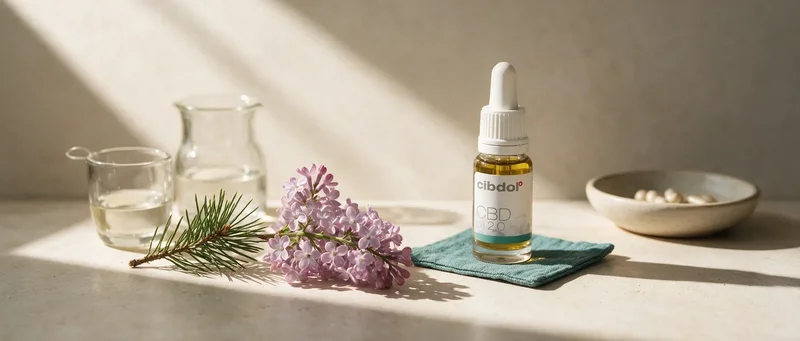
Hemp aroma gets talked about in pine and citrus. Terpineol sits somewhere else: a floral monoterpene alcohol whose name hides four isomers and whose boiling point is reported inconsistently.
Sabinene Explained: Formula, Family, Boiling Point
Sabinene sits in the terpene family, with the formula C10H16 and a molar mass around 136 g/mol. Here is what the chemistry fixes, and where the record for this single molecule stops.
Phytol: From Chlorophyll to a Boiling Point
A terpenoid with an alcohol group, a diterpene backbone, and a boiling point that only makes sense with its pressure condition attached. Here is what the record holds, and where it stops.
Ocimene, Described in Four Lines
A short, precise look at one aromatic molecule: its family in the terpene group, the four words used for its smell, and what the approximate 100 °C figure actually marks.
Guaiol: 15 Carbons, One Hydroxyl Group, Two Boiling Points
Guaiol is a sesquiterpene alcohol: a 15-carbon skeleton carrying a hydroxyl group. Here is its structure, its aroma profile, and why one molecule ends up with two very different boiling point figures.

Geraniol: Formula, Family, Boiling Point
Geraniol is a monoterpene alcohol with the formula C10H18O and a boiling point near 230 °C at atmospheric pressure. Here is what the chemistry pins down, and where the published record still opens out.
What Is Farnesene? Start With the Formula
Farnesene is a C15H24 hydrocarbon, and the name covers a family of isomers rather than a single compound. Here is the chemistry, the difference from farnesol, and what the plant record says.
Eucalyptol on a Lab Report: One Compound, Two Names
Eucalyptol and 1,8-cineole are the same molecule written two ways. Here are the terpene basics, the number that keeps getting quoted, and why the batch document matters more than the spelling.
