How to read a certificate of analysis COA
Definition
One published Cibdol batch certificate, read top to bottom, with the difference between a Conform pass and a measured figure spelled out.
A certificate of analysis is a report on one batch of one product, and it holds more verdicts than numbers. Knowing how to read a certificate of analysis is largely a matter of seeing which column carries a figure and which carries a pass. The document read here is Cibdol's published certificate for batch 260084. Your own batch number is printed on the bottom of the bottle or box, and the batch and COA lookup on this site matches that number to the certificate behind it.
Start with the batch number, not the product name
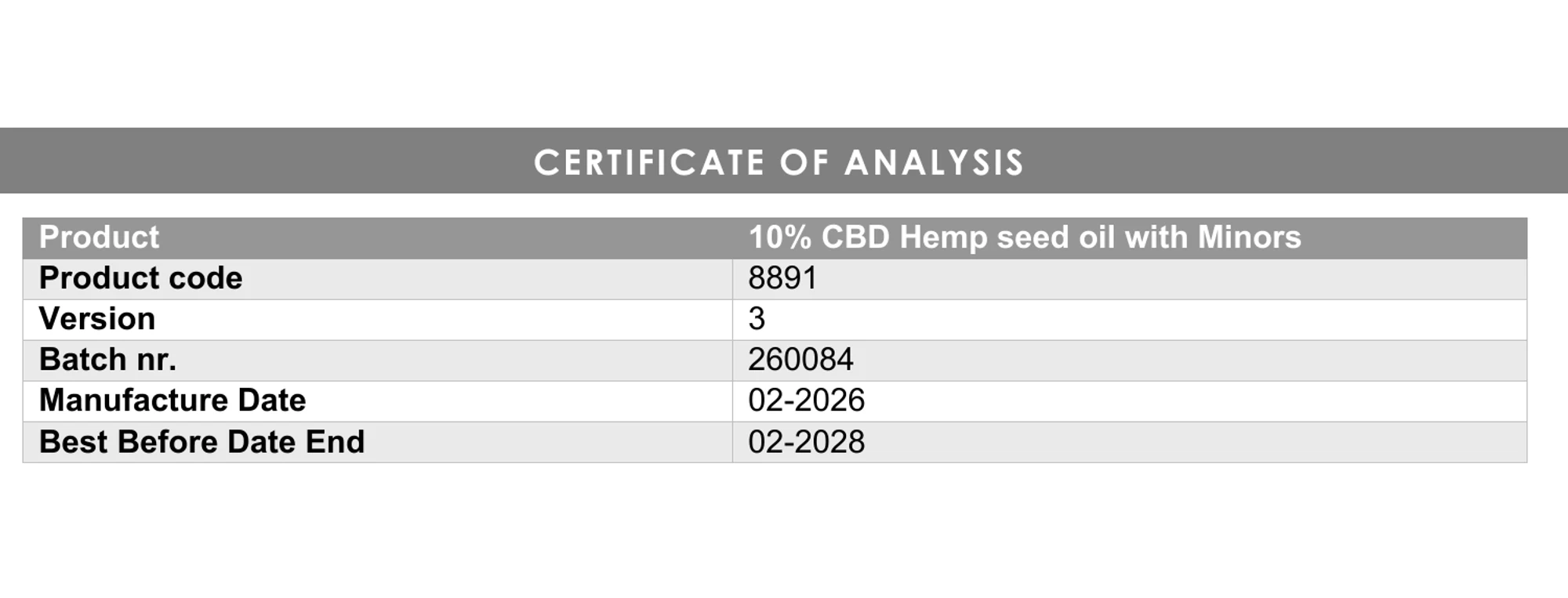
A certificate covers one batch of one product rather than a product line, and the header of batch 260084 identifies a 10% CBD hemp seed oil with minors, product code 8891, version 3, made in 02-2026 and best before the end of 02-2028. [1] Two bottles of the same oil bought a year apart sit behind two different certificates.
Cibdol publishes one certificate per batch rather than one per product, 16 of them at the time of writing, and the number printed on the bottom of your bottle or box is what finds the right one. Sold-out batches stay listed, so an oil you finished months ago still has its report.
Most of the result column says Conform
Every tested line runs across four columns: the item, its specification, the result and the method used. Most result cells read Conform, which records that the batch met the specification rather than printing the figure that was measured. [1] The number you were hoping to read is in the specification column.
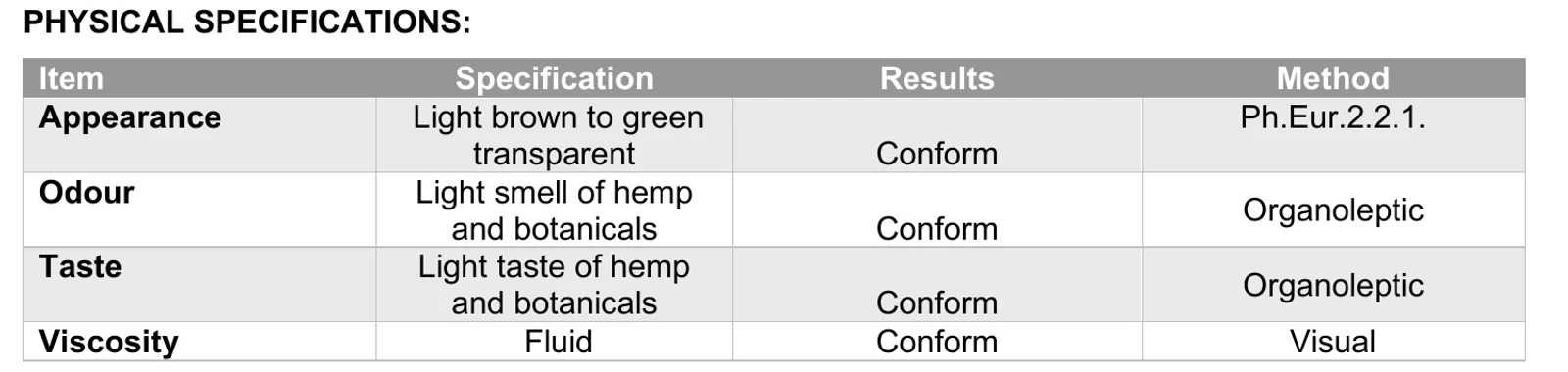
The physical block shows the pattern plainly. Appearance is specified as light brown to green transparent and judged against Ph.Eur. 2.2.1, odour and taste of hemp and botanicals are assessed organoleptically, by smell and taste, and viscosity is given as fluid and judged visually. [1]
The cannabinoid lines and the THC residue
Active ingredients are expressed per 1 ml and list cannabidiol, cannabidiolic acid, cannabigerol, cannabichromene and cannabinol, each from Cannabis sativa flower extract, each given as a permitted range rather than a single figure, all measured by UHPLC-DAD, a chromatographic method with an ultraviolet detector. [1] A range is what a manufacturing specification commits to across a production run.
The terpene profile mix line sits in the same block and carries In-House as its method, the laboratory's own procedure rather than a published standard. [1] Further down, THC appears lower on the page under a cannabinoid residues heading, with a specification of less than 0.05% and UHPLC-DAD as the method. [1]
What the purity limits are measured against
Cadmium and arsenic must come in below 1.0 ppm, mercury below 0.1 ppm and lead below 3.0 ppm, with Commission Regulation (EU) 2023/915 of 25 April 2023 on maximum levels for certain contaminants in food named as the source of those limits. [2] A limit with a named instrument behind it can be looked up; a limit with nothing behind it cannot.
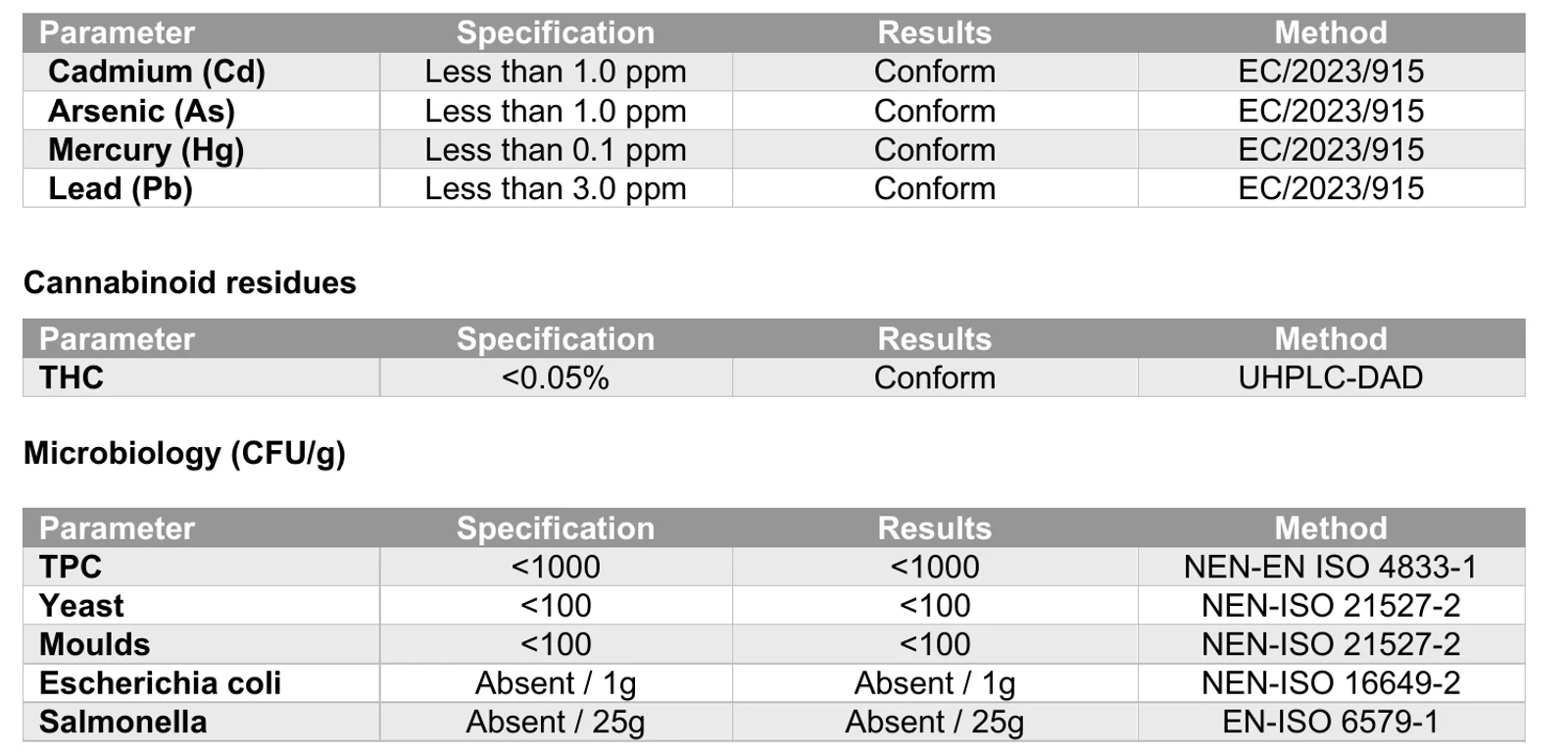
Microbiology is reported in colony forming units per gram against named ISO methods, with Escherichia coli absent in 1 g and Salmonella absent in 25 g. [1] The sample weight is part of the finding, since absent in 25 g and absent in 1 g are not the same statement.
Who signed it, and what accredited would add
The certificate does not name the company that wrote it. Nothing is printed above the certificate of analysis bar on batch 260084 and no issuer name appears in the page text, so the only mark of authorship the document carries is the sign-off at the end, dated 07-05-2026, giving the QA manager as i.o. P. Koster. [1] An unattributed report is worth noticing in itself.

Cibdol records the issuer beside each certificate in the batch lookup rather than on the certificate itself. All 16 rows currently name CureSupport Nederland B.V., which manufactures the products, so the row and not the document is where you read who wrote the report. Which company analysed a batch is not fixed for the brand either; it is recorded per certificate, so it is worth checking for the batch in hand rather than carrying over from another one.
Accredited is a narrower word than it looks. ISO/IEC 17025:2017 sets the general requirements for the competence, impartiality and consistent operation of testing and calibration laboratories, and ISO does not accredit anyone against it; that is granted by a national accreditation body. [3]
Často kladené dotazy
8 otázekWhat does Conform mean in the result column?
Where is the batch number on the pack?
Does one certificate cover every bottle of the same oil?
Why are the cannabinoid amounts shown as ranges?
How is THC handled on the certificate?
Which rules set the heavy metal limits?
How do I find out who analysed my batch?
Does ISO/IEC 17025 accreditation come from ISO?
O tomto článku


Luke Sholl has been writing about cannabinoids, CBD, and the broader benefits of nature since 2011. His background includes first-hand cannabis cultivation experience spanning the full seed-to-harvest lifecycle across so
Tento wiki článek byl zpracován s pomocí umělé inteligence a zkontrolován recenzentem Luke Sholl, CBD & wellness writer. Redakční dohled: Joshua Askew.
Zdravotní upozornění. Tento obsah je pouze informativní a nepředstavuje lékařskou radu. Před užitím jakékoli látky se poraďte s kvalifikovaným zdravotnickým pracovníkem.
Reference (3)
- [1]Cibdol batch certificate of analysis, batch 260084, 10% CBD hemp seed oil with minors, issued by CureSupport Nederland B.V., signed 07-05-2026. Source
- [2]Commission Regulation (EU) 2023/915 of 25 April 2023 on maximum levels for certain contaminants in food and repealing Regulation (EC) No 1881/2006. Source
- [3]ISO/IEC 17025:2017. General requirements for the competence of testing and calibration laboratories. International Organization for Standardization. Source
