

Sleep inertia and the transition to alertness
Definition
Scientific studies report that sleep inertia can produce temporary performance drops lasting from a few minutes to several hours depending on timing and prior sleep.
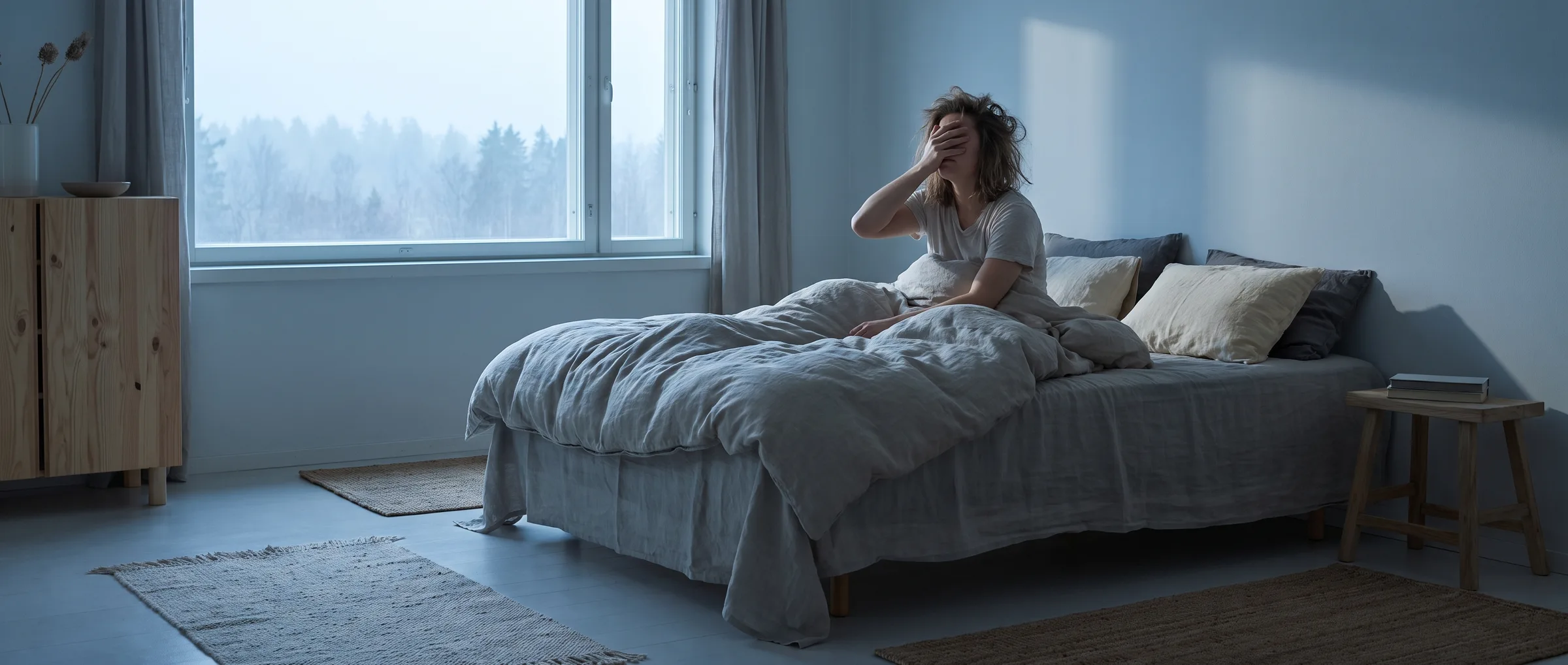
Sleep inertia is a transitional state of lowered arousal immediately after waking from sleep that produces a temporary drop in performance. A later review describes it as the grogginess felt on waking, with measurable decrements in cognitive performance that fade as time awake increases, observed both in tightly controlled laboratory studies and in real-world settings [1][2]. A 2019 review summarises that the performance decrements of sleep inertia are exaggerated by prior sleep loss and by the time of day at which a person wakes [2].
Measured duration across different conditions
How long it lasts depends on the study. A 2000 review reports durations from 1 minute to 4 hours across studies, notes that in the absence of major sleep deprivation it rarely exceeds 30 minutes, and says these results should be read according to the type of task and the measure used, as different cognitive functions are probably not equally sensitive to it [1].
After an ordinary night the tail can be long. In a study that measured subjective alertness and cognitive throughput during the first 4 hours after habitual wake time, following a full 8-hour sleep episode on 3 consecutive days, both were significantly impaired on waking and took 2 to 4 hours to near their plateau, with fitted time constants of 0.67 hours for subjective alertness and 1.17 hours for cognitive performance [3]. In the same full-night study the impairment on waking was present under both conditions tested: when participants got out of bed, ate breakfast, showered and were in ordinary indoor room light of about 150 lux, and when they stayed in bed in very dim light of 10 to 15 lux eating small hourly snacks [3].
Brain blood flow during the transition awake
Waking has two speeds in the brain. A PET study of regional blood flow after waking from stage 2 sleep describes a rapid return of consciousness followed by a relatively slow return of alertness, 20 to 30 minutes later. Blood flow was re-established first in the brainstem and thalamus, and over the following 15 minutes further increases appeared mainly in the front regions of the cortex [6].
Influence of sleep stage and circadian timing
The 2000 review names the sleep stage before waking as one of the most critical factors: abrupt awakening during slow wave sleep produced more sleep inertia than awakening in stage 1 or 2, with REM sleep intermediate. It adds that prior sleep deprivation usually intensifies sleep inertia because it increases slow wave sleep [1].
However, the stage effect is not detected in every study. In the full-night study most awakenings came from REM sleep, stage 2 or stage 1, and no effect of sleep stage at awakening on either the severity of sleep inertia or the time course of its dissipation could be detected. Separately, a 2017 review reports that recovery sleep after sleep deprivation amplifies sleep inertia, but that the effects of deep sleep vary with task and timing [3][4].
Body-clock timing matters independently of stage. The 2000 review states there is no direct evidence of a circadian rhythm in sleep inertia, although it appeared more intense when waking near the low point of core body temperature. A 2008 forced desynchrony study in 12 adults then measured one: after awakenings from stage 2, the drop in serial addition performance across the first 20 minutes awake was 3.6 times larger in the biological night, roughly 23:00 to 03:00 in those participants, than in the biological day, roughly 15:00 to 19:00, and the rhythm remained when awakenings from all stages were included [1][5].
Nap duration and reactive countermeasures
Nap length changed what happened straight after waking in one study. Twenty-four healthy young adults who were good sleepers and not regular nappers each went through five conditions after a night restricted to about 5 hours at home: an afternoon nap at 15:00 of precisely 5, 10, 20 or 30 minutes of sleep, or no nap. The 30-minute nap produced a period of impaired alertness and performance immediately afterwards, which the authors describe as indicative of sleep inertia, followed by improvements lasting up to 155 minutes, while the 10-minute nap was followed by immediate improvements in all outcome measures compared with no nap [7].
A structured review of countermeasures used after waking, such as caffeine, light and temperature, concluded that the current literature does not provide a convincing evidence base for any of them. It judged caffeine perhaps the best option while noting it is most effective when taken before sleep, so not strictly an after-waking measure, found light and temperature promising for subjective alertness with performance effects still to be established, and recommended that safety-critical tasks are avoided immediately after waking [8].
Frequently Asked Questions
8 questionsWhat is sleep inertia?
How long does sleep inertia normally last?
Why does consciousness return faster than alertness?
Does waking from deep sleep make grogginess worse?
Does the time of night alter morning grogginess?
Can afternoon naps cause sleep inertia?
Do post-waking countermeasures work?
What should be done right after waking?
About this article


Luke Sholl has been writing about cannabinoids, CBD, and the broader benefits of nature since 2011. His background includes first-hand cannabis cultivation experience spanning the full seed-to-harvest lifecycle across so
This wiki article was drafted with AI assistance and reviewed by Luke Sholl, CBD & wellness writer. Editorial oversight by Joshua Askew.
Medical disclaimer. This content is for informational purposes only and does not constitute medical advice. Consult a qualified healthcare provider before use of any substance.
References (8)
- [1]Tassi P, Muzet A. Sleep inertia. Sleep Medicine Reviews 2000;4(4):341-353. doi:10.1053/smrv.2000.0098, PMID 12531174 Source
- [2]Hilditch CJ, McHill AW. Sleep inertia: current insights. Nature and Science of Sleep 2019;11:155-165. doi:10.2147/NSS.S188911, PMID 31692489 Source
- [3]Jewett ME, Wyatt JK, Ritz-De Cecco A, Khalsa SB, Dijk DJ, Czeisler CA. Time course of sleep inertia dissipation in human performance and alertness. Journal of Sleep Research 1999;8(1):1-8. doi:10.1111/j.1365-2869.1999.00128.x, PMID 10188130 Source
- [4]Trotti LM. Waking up is the hardest thing I do all day: sleep inertia and sleep drunkenness. Sleep Medicine Reviews 2017;35:76-84. doi:10.1016/j.smrv.2016.08.005, PMID 27692973 Source
- [5]Scheer FAJL, Shea TJ, Hilton MF, Shea SA. An endogenous circadian rhythm in sleep inertia results in greatest cognitive impairment upon awakening during the biological night. Journal of Biological Rhythms 2008;23(4):353-361. doi:10.1177/0748730408318081, PMID 18663242 Source
- [6]Balkin TJ, Braun AR, Wesensten NJ, Jeffries K, Varga M, Baldwin P, Belenky G, Herscovitch P. The process of awakening: a PET study of regional brain activity patterns mediating the re-establishment of alertness and consciousness. Brain 2002;125(10):2308-2319. doi:10.1093/brain/awf228, PMID 12244087 Source
- [7]Brooks A, Lack L. A brief afternoon nap following nocturnal sleep restriction: which nap duration is most recuperative? Sleep 2006;29(6):831-840. doi:10.1093/sleep/29.6.831, PMID 16796222 Source
- [8]Hilditch CJ, Dorrian J, Banks S. Time to wake up: reactive countermeasures to sleep inertia. Industrial Health 2016;54(6):528-541. doi:10.2486/indhealth.2015-0236, PMID 27193071 Source
Related Articles
Pink noise and the evidence behind coloured sound
A review of acoustic colour definitions, evidence ratings for continuous sound, and laboratory findings on pink noise and sleep structure.
What core sleep means on a wearable device
Core sleep on modern smartwatches corresponds to laboratory light sleep, stages N1 and N2. Earlier research used the term differently, while consumer devices show measurable differences from clinical polysomnography.
Why do we sleep and what the research measures
Researchers have proposed several explanations for sleep, from energy conservation to neural maintenance. This review examines what empirical studies have measured in humans and animals.
Biphasic sleep across history and modern science
This article outlines historical and modern research on biphasic sleep, contrasting preindustrial accounts with field studies and controlled polyphasic trials.
The military sleep method, origins and evidence
The military sleep method traces back to a 1981 book by track coach Bud Winter. Popular retellings claim fast results, but the method itself has not been tested.
Understanding sleep debt and how recovery sleep works
Sleep debt reflects the cumulative difference between required and obtained rest. Laboratory trials reveal how performance deficits accumulate over time and examine the dynamics of subsequent recovery.
How accurate is a sleep tracker at scoring rest stages
Validation studies compare consumer sleep technology with laboratory recordings. Trackers detect sleep reliably but misclassify wakefulness and show inconsistent agreement on stages.
Yoga nidra session steps and scientific evidence
Yoga nidra is a structured guided relaxation practice. Research has evaluated its physiological patterns and measured overnight sleep changes with mixed results.
What objective studies reveal about sleeping positions
Sensor data show adults spend over half the night on their side, with shifts decreasing as age increases. Evidence linking spinal symptoms to specific positions remains thin.
