



Yoga nidra session steps and scientific evidence
Definition
A review of yoga nidra practice structure, neuroimaging data, overnight sleep recordings and current clinical trial evaluations.
Yoga nidra is a structured relaxation practice that combines mental imagery with resting quietly while remaining awake. Researchers have investigated its physiological markers during sessions and evaluated how it affects nighttime rest in clinical and laboratory settings.
Origins and structure of a session
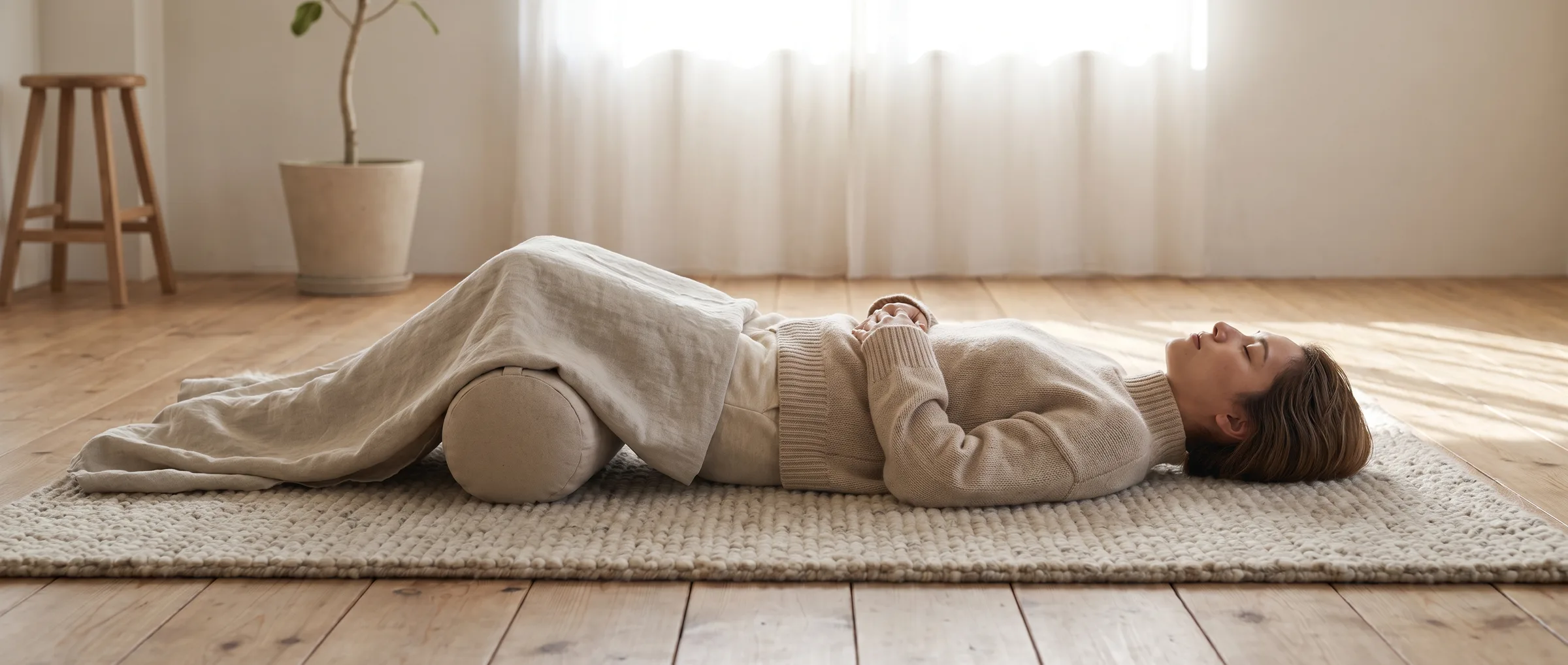
Yoga nidra, also called yogic sleep, is described in a 2022 narrative review as a relaxation practice combining guided mental imagery with lying in Shavasana, or corpse pose. The review gives its goal as a profound state of relaxation that differs from sleep because awareness of the surroundings remains, dating the systematised modern form to the 1960s writings of Swami Satyananda Saraswati. [1]
The same review sets out the order of a session: preparation lying on the back with closed eyes, staying still, awake and following spoken instructions; a short personal resolution, the sankalpa, repeated mentally three times; a rotation of awareness through body parts in a fixed sequence; awareness of the breath; recall of feelings and sensations; visualisation of scenes; the resolution repeated again; and a slow return of attention to outside sounds, the body and surroundings. [1]
Brain activity and recordings during practice
A PET study scanned participants twice, once while listening to speech with eyes closed and once during yoga nidra. During the practice, binding of the tracer raclopride in the ventral striatum fell by 7.9 percent, which the authors equate to a 65 percent increase in endogenous dopamine release. Participants reported less desire for action and more vivid sensory imagery during yoga nidra, but the level of gratification and the depth of relaxation did not differ between the two conditions. [3]

In 30 apparently healthy volunteers aged 18 to 60, EEG polysomnography during a session after two weeks of practice was scored as wake across all 26 reported recordings, while delta power over central areas rose and over prefrontal areas fell compared with before the session. The authors describe novice practice as an awake state with local signs of slow waves, which they call local sleep. Sleep diaries recorded changes in duration, efficiency and quality after two weeks, though authors note overnight polysomnography was not done. [4]
Sleep laboratory studies and overnight recordings
In a preliminary randomised sleep-laboratory trial, 22 adults who described themselves as having trouble sleeping lay quietly for 90 minutes on a first visit; on a second visit half were randomised to practise yoga nidra for the first 30 minutes. Comparing the change between visits, there were no between-group differences in alpha EEG power, heart rate variability or sleep onset latency. Respiratory rate fell by 1.4 breaths per minute during practice and 2.1 afterwards, against rises of 0.2 and 0.4 in the control group, which authors say needs confirming in definitive studies. [6]
In a pre-post study of healthy young male volunteers new to the practice, 41 were enrolled and compared with their baseline overnight polysomnography. After four weeks of practice, sleep efficiency was 3.62 percent higher, wake after sleep onset was 20 minutes shorter and delta power during deep sleep was 4.19 microvolts squared higher, while changes in total sleep time and time in bed were not statistically significant. The authors state that no active control group was used. [5]
Clinical trials and pooled research evidence
In a randomised trial delivered online through pre-recorded audio, 362 participants were assigned to 11 minutes of yoga nidra, 30 minutes of yoga nidra, 10 minutes of music or a waiting list daily for two months, assessing stress, rumination, life satisfaction, diurnal salivary cortisol and sleep via the Pittsburgh Sleep Quality Index questionnaire. Compared with the waiting list, the 11-minute group showed significant differences on stress and rumination (effect sizes d = 0.08 to 0.16), but its difference on the sleep questionnaire fell just short of statistical significance. The 30-minute group's sleep questionnaire scores did differ significantly from the waiting list, by about 12 percent of a standard deviation, results framed by authors as small effects. [9]
A systematic review of randomised trials published up to 31 March 2025 found six trials with 244 participants, drawn from groups including healthcare workers and sportspeople. Most trials reported significant changes in sleep onset latency, total sleep time and sleep efficiency among participants practising yoga nidra, against progressive muscle relaxation and music-based relaxation. However, most carried moderate to high risk of bias, mainly from lack of blinding and incomplete outcome reporting, and adverse events and safety data were not accurately reported. [7]
An integrative review that searched four databases found 29 studies using yoga nidra as an intervention: 12 randomised controlled trials, 13 quasi-experimental studies, 3 mixed-methods studies and 1 qualitative study, with sleep as one of seven outcome themes. The reviewers describe yoga nidra as guided meditation that, unlike traditional yoga, requires no yoga poses, and report that differences in populations, session length, frequency and duration made it difficult to draw conclusions. [2]
A 2026 systematic review and meta-analysis restricted to adults with poor scores on sleep questionnaires could pool only five unique studies. On the Pittsburgh Sleep Quality Index, two randomised trials with 181 participants showed a difference that was not statistically significant, and on a second sleep questionnaire two randomised trials with 99 participants also showed no significant effect; only two observational studies with 45 participants showed a significant difference. The authors rate the certainty of the evidence as very low, call the findings preliminary and hypothesis-generating, and note that the trials were concentrated in India. [8]
Frequently Asked Questions
8 questionsWhat does the term yoga nidra mean?
How does yoga nidra differ from seated meditation?
What are the main stages included in a typical session?
Does brain activity during a session resemble sleep?
What did brain scans reveal about dopamine during practice?
Did laboratory testing show differences in time to begin sleeping?
What did overnight sleep tracking show after four weeks of practice?
What does pooled trial evidence conclude about night-time rest?
About this article

Luke Sholl has been writing about cannabinoids, CBD, and the broader benefits of nature since 2011. His background includes first-hand cannabis cultivation experience spanning the full seed-to-harvest lifecycle across so
This wiki article was drafted with AI assistance and reviewed by Luke Sholl, CBD & wellness writer. Editorial oversight by Joshua Askew.
Medical disclaimer. This content is for informational purposes only and does not constitute medical advice. Consult a qualified healthcare provider before use of any substance.
References (9)
- [1]Pandi-Perumal SR, Spence DW, Srivastava N, Kanchibhotla D, Kumar K, Sharma GS, Gupta R, Batmanabane G. The Origin and Clinical Relevance of Yoga Nidra. Sleep and Vigilance 2022;6(1):61-84. doi:10.1007/s41782-022-00202-7, PMID 35496325 Source
- [2]Musto S, Hazard Vallerand A. Exploring the uses of yoga nidra: An integrative review. Journal of Nursing Scholarship 2023;55(6):1164-1178. doi:10.1111/jnu.12927, PMID 37489597 Source
- [3]Kjaer TW, Bertelsen C, Piccini P, Brooks D, Alving J, Lou HC. Increased dopamine tone during meditation-induced change of consciousness. Cognitive Brain Research 2002;13(2):255-259. doi:10.1016/S0926-6410(01)00106-9, PMID 11958969 Source
- [4]Datta K, Mallick HN, Tripathi M, Ahuja N, Deepak KK. Electrophysiological Evidence of Local Sleep During Yoga Nidra Practice. Frontiers in Neurology 2022;13:910794. doi:10.3389/fneur.2022.910794, PMID 35903117 Source
- [5]Datta K, Bhutambare A, V. L. M, Narawa Y, Srinath R, Kanitkar M. PLOS ONE 2023;18(12):e0294678. doi:10.1371/journal.pone.0294678, PMID 38091317 Source
- [6]Sharpe E, Butler MP, Clark-Stone J, Soltanzadeh R, Jindal R, Hanes D, Bradley R. A closer look at yoga nidra- early randomized sleep lab investigations. Journal of Psychosomatic Research 2023;166:111169. doi:10.1016/j.jpsychores.2023.111169, PMID 36731199 Source
- [7]Dutta A, Mooventhan A, Nivethitha L, Dharani E. Journal of Integrative and Complementary Medicine 2026;32(3):235-241 (published online 2025-10-27). doi:10.1177/27683605251390728, PMID 41144325 Source
- [8]Singh S, Dhanlika D, Singh U, Haldar P, Sharma G. Sleep and Breathing 2026;30(2):144. doi:10.1007/s11325-026-03685-0, PMID 42043659 Source
- [9]Moszeik EN, Rohleder N, Renner K. The Effects of an Online Yoga Nidra Meditation on Subjective Well-Being and Diurnal Salivary Cortisol: A Randomised Controlled Trial. Stress and Health 2025;41(3):e70049. doi:10.1002/smi.70049, PMID 40373021 Source
Related Articles
Pink noise and the evidence behind coloured sound
A review of acoustic colour definitions, evidence ratings for continuous sound, and laboratory findings on pink noise and sleep structure.
What core sleep means on a wearable device
Core sleep on modern smartwatches corresponds to laboratory light sleep, stages N1 and N2. Earlier research used the term differently, while consumer devices show measurable differences from clinical polysomnography.
Why do we sleep and what the research measures
Researchers have proposed several explanations for sleep, from energy conservation to neural maintenance. This review examines what empirical studies have measured in humans and animals.
Biphasic sleep across history and modern science
This article outlines historical and modern research on biphasic sleep, contrasting preindustrial accounts with field studies and controlled polyphasic trials.
The military sleep method, origins and evidence
The military sleep method traces back to a 1981 book by track coach Bud Winter. Popular retellings claim fast results, but the method itself has not been tested.

Understanding sleep debt and how recovery sleep works
Sleep debt reflects the cumulative difference between required and obtained rest. Laboratory trials reveal how performance deficits accumulate over time and examine the dynamics of subsequent recovery.
How accurate is a sleep tracker at scoring rest stages
Validation studies compare consumer sleep technology with laboratory recordings. Trackers detect sleep reliably but misclassify wakefulness and show inconsistent agreement on stages.
What objective studies reveal about sleeping positions
Sensor data show adults spend over half the night on their side, with shifts decreasing as age increases. Evidence linking spinal symptoms to specific positions remains thin.
How long can you go without sleep
Documented records describe individuals staying awake for days, but laboratory evaluations show that cognitive lapses and sensory changes begin within the first 24 hours.
