CBN for sleep, what the human evidence shows
Definition
A critical review of the clinical evidence on cannabinol, examining early combination studies and recent sleep laboratory trials.
When consumers search for cbn for sleep, they encounter widespread commercial claims about nighttime rest, but the clinical record tells a much more cautious story. Controlled human trials have evaluated cannabinol alone and in combination, yet neither of the two modern randomised trials met its primary outcome. While laboratory interest continues, published evidence has not established that cannabinol acts as an effective sleep aid on its own.
Where cannabinol comes from and how it forms
Cannabinol is not made by the plant in any quantity. It forms when delta-9-tetrahydrocannabinol oxidises, so it accumulates as harvested cannabis ages, and forensic laboratories use the ratio of the two as a marker of long storage. A pharmacy stability study describes the same reaction as oxidative degradation of THC to cannabinol.
Aged cannabis traditionally developed a reputation for causing sedation, and because stored material naturally contains higher concentrations of cannabinol, public perception linked the compound directly to tiredness. However, an observational correlation between material age and drowsiness does not establish an active pharmacological sedative effect.
The 1975 human interaction studies
The first controlled human test of cannabinol was published in 1975. Five male volunteers took placebo, cannabinol alone, THC alone and two combinations, each a week apart. THC raised heart rate; cannabinol alone did not. On a sixty-six-item adjective scale the volunteers reported feeling drugged, drunk, dizzy and drowsy after THC, and reported none of that after cannabinol alone. [1]
In the same 1975 study the combination of cannabinol with THC produced more of the reported drugged, drunk, dizzy and drowsy responses than THC alone. The authors called those effects small and said they could not account for the greater potency reported when whole plant material is used. [1]
A second study published in the same year gave volunteers THC with placebo, with cannabinol and with cannabidiol. Adding cannabinol produced no detectable change in the quality, intensity or duration of the THC effects. The authors saw no reason to change the practice of setting doses for clinical work on THC content alone. [2] These early trials left the question of standalone sedation unresolved.
The 2021 systematic literature review
A 2021 review set out to answer one question: is there enough clinical evidence for the sleep claims made about cannabinol. It searched PubMed and MEDLINE, screened the abstracts of ninety-nine human studies and read eight in full. It identified no published clinical trial that measured cannabinol against a validated sleep questionnaire or against overnight recording, and concluded that the published evidence was insufficient to support sleep claims. [3]
The same review described the research base as dated and limited: most human work came from the 1970s and 1980s, sample sizes were small and narrow, and studies that measured sedation or fatigue at all were rare. It also found the evidence that cannabinol produces cannabis-like effects in people to be mixed, with most of it showing no such effect. [3]
The review added that the amounts of cannabinol in products marketed for sleep sit far below what a trial would need to test, and said future trials should use substantially higher amounts than those products carry. [3]
Findings from the 2024 outpatient trial
The first trial to answer the 2021 review ran between May and November 2022 and was published in 2024. It was double-blind, randomised and placebo-controlled, with two hundred and ninety-three adults aged eighteen to fifty-five who rated their own sleep as poor or very poor. Five arms took a capsule nightly for seven consecutive nights: placebo, cannabinol alone, or cannabinol with one of three amounts of cannabidiol. [4]
That trial's primary outcome was self-rated sleep quality, and cannabinol did not change it to a statistically significant degree. The authors described the effect as non-significant but potentially meaningful, which is a careful way of saying the study did not demonstrate what it set out to test. [4]
Two secondary measures did move against placebo in that trial: participants woke fewer times during the night, and their overall sleep disturbance score fell. Three others did not move at all, namely how long it took to fall asleep, how long they lay awake after first falling asleep, and how tired they felt the next day. [4]
Adding cannabidiol to cannabinol did not improve any result in that trial, at any of the three amounts tested. The combination arms did not outperform cannabinol on its own. [4]
Overnight sleep laboratory findings from 2026
In 2026 cannabinol was finally measured in a sleep laboratory. A randomised, double-blind, placebo-controlled crossover trial gave twenty adults aged twenty-five to sixty-five a single oral dose at a lower amount, at a higher amount, or matched placebo, one night per arm with a two-week washout, each night recorded by full polysomnography. Seventeen of the twenty were women and the mean age was forty-two. Recruitment ran at a sleep research institute in Sydney between August 2022 and September 2023, and every participant completed the protocol. [6]
That trial's primary outcome was wake after sleep onset, the total minutes spent awake after first falling asleep, measured by polysomnography rather than by self-report. Neither amount changed it significantly. The higher amount shifted it by about six minutes and the lower amount by about four, and in both cases the confidence interval crossed zero. [6]
Four secondary measures did move on the higher amount: more stage-two non-REM sleep, higher self-rated sleep quality, shorter time to fall asleep, and fewer electroencephalographic arousals. These were secondary outcomes from a single night in twenty people, so they raise a question rather than answer it, and the authors called for larger and longer trials. [6]
Two hundred and forty-seven adverse events, all mild to moderate, were recorded across the three arms of that trial, placebo included. [6]
Combining cannabinol with other compounds
A separate randomised controlled trial in one thousand seven hundred and ninety-three adults with disturbed sleep compared six four-week capsule regimens. Formulations combining cannabidiol with cannabinol did not outperform cannabidiol on its own, and did not outperform melatonin on its own. The authors concluded that adding low amounts of cannabinol may not improve a cannabidiol or melatonin formulation. [5]
Cannabinol and melatonin are commonly sold in the same capsule or bottle, and there is early laboratory reason to look at that pairing. In cell work and in mice, cannabinol strongly inhibited the liver enzyme that clears melatonin and raised the amount of melatonin reaching the bloodstream roughly fourfold. This is preclinical work, not a human finding, and it describes a possible interaction rather than an established one. [7]
Regulatory status in the European Union
No health claim about cannabinol and sleep is authorised in the European Union. The register of permitted claims under Regulation (EC) 1924/2006, consolidated in Regulation (EU) 432/2012, contains no entry for cannabinol.
In the European Union, cannabinoid extracts of Cannabis sativa and products derived from them are treated as novel foods, which means authorisation is required before sale as food and the assessment is about safety, not about effect.
Formulations and laboratory testing
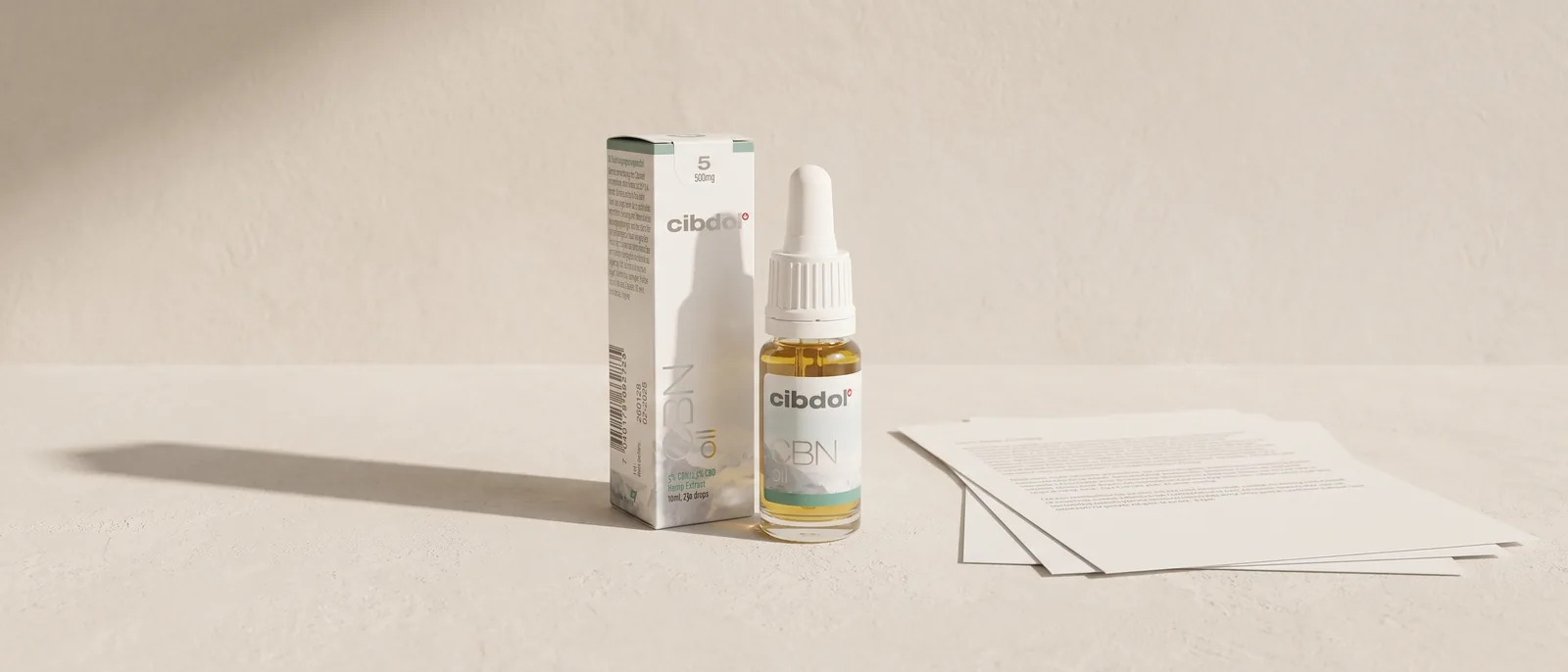
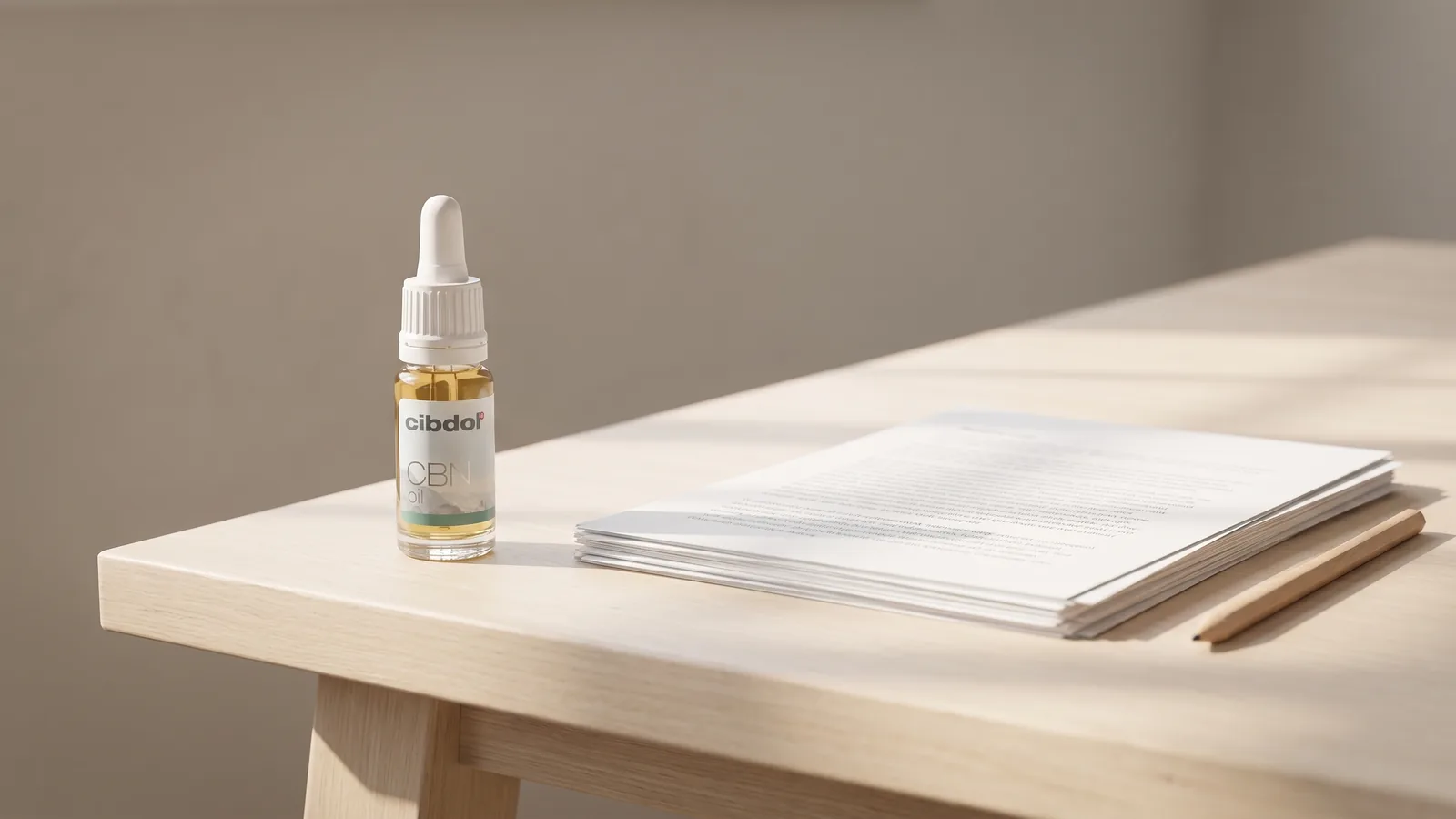
Cibdol offers CBN Oil 5% + CBD 2.5%, formulated with olive oil as the carrier alongside hemp extract and natural terpenes. In the evening range, Stay Asleep Capsules combine cannabinol and cannabidiol with hops and griffonia extracts without melatonin, while Complete Sleep provides a liquid formulation combining both cannabinoids with chamomile and lavender extracts. Every Cibdol batch is analysed by an independent laboratory and the certificate is published.
The quantity tested in clinical settings often differs substantially from commercial retail formulations. Deciding how to approach sleep health remains a conversation to have with a doctor or pharmacist. This article describes published research and does not give medical advice.
Frequently Asked Questions
8 questionsDoes cannabinol have proven effects on sleep?
What did the 2024 trial find?
What did the 2026 sleep laboratory trial find?
Why did the two 1975 studies reach different conclusions?
Where does cannabinol come from?
Does adding cannabidiol improve outcomes?
Can brands make sleep claims for cannabinol in Europe?
What is the difference between a primary and a secondary outcome?
About this article

Luke Sholl has been writing about cannabinoids, CBD, and the broader benefits of nature since 2011. His background includes first-hand cannabis cultivation experience spanning the full seed-to-harvest lifecycle across so
This wiki article was drafted with AI assistance and reviewed by Luke Sholl, CBD & wellness writer. Editorial oversight by Joshua Askew.
Medical disclaimer. This content is for informational purposes only and does not constitute medical advice. Consult a qualified healthcare provider before use of any substance.
References (8)
- [1]Karniol IG, Shirakawa I, Takahashi RN, Knobel E, Musty RE. Effects of delta9-tetrahydrocannabinol and cannabinol in man. Pharmacology 1975;13(6):502-512. Source
- [2]Hollister LE, Gillespie HK. Interactions in man of delta-9-tetrahydrocannabinol. II. Cannabinol and cannabidiol. Clinical Pharmacology and Therapeutics 1975;18(1):80-83. Source
- [3]Corroon J. Cannabinol and sleep: separating fact from fiction. Cannabis and Cannabinoid Research 2021. Source
- [4]Bonn-Miller MO, Feldner MT, Bynion T-M, et al. A double-blind, randomized, placebo-controlled study of the safety and effects of CBN with and without CBD on sleep quality. Experimental and Clinical Psychopharmacology 2024. Source
- [5]Saleska JL, Bryant C, Kolobaric A, et al. The safety and comparative effectiveness of non-psychoactive cannabinoid formulations for the improvement of sleep. Journal of the American Nutrition Association 2024. Source
- [6]Lavender IG, Marshall NS, McCartney D, et al. Cannabinol for acute treatment of insomnia disorder in a randomized placebo-controlled crossover trial. Journal of Sleep Research 2026;35(4). Source
- [7]Anderson LL, Hawkins NA, Yip S, Udoh M, Kearney JA, Arnold JC. Preclinical evidence for a drug-drug interaction between cannabinol and melatonin. Basic and Clinical Pharmacology and Toxicology 2025. Source
- [8]Tsumura Y, Aoki R, Tokieda Y, Akutsu M. A survey of the potency of Japanese illicit cannabis in fiscal year 2010. Forensic Science International 2012. Source
Related Articles
Pink noise and the evidence behind coloured sound
A review of acoustic colour definitions, evidence ratings for continuous sound, and laboratory findings on pink noise and sleep structure.
What core sleep means on a wearable device
Core sleep on modern smartwatches corresponds to laboratory light sleep, stages N1 and N2. Earlier research used the term differently, while consumer devices show measurable differences from clinical polysomnography.
Why do we sleep and what the research measures
Researchers have proposed several explanations for sleep, from energy conservation to neural maintenance. This review examines what empirical studies have measured in humans and animals.
Biphasic sleep across history and modern science
This article outlines historical and modern research on biphasic sleep, contrasting preindustrial accounts with field studies and controlled polyphasic trials.
The military sleep method, origins and evidence
The military sleep method traces back to a 1981 book by track coach Bud Winter. Popular retellings claim fast results, but the method itself has not been tested.
Understanding sleep debt and how recovery sleep works
Sleep debt reflects the cumulative difference between required and obtained rest. Laboratory trials reveal how performance deficits accumulate over time and examine the dynamics of subsequent recovery.
How accurate is a sleep tracker at scoring rest stages
Validation studies compare consumer sleep technology with laboratory recordings. Trackers detect sleep reliably but misclassify wakefulness and show inconsistent agreement on stages.
Yoga nidra session steps and scientific evidence
Yoga nidra is a structured guided relaxation practice. Research has evaluated its physiological patterns and measured overnight sleep changes with mixed results.
What objective studies reveal about sleeping positions
Sensor data show adults spend over half the night on their side, with shifts decreasing as age increases. Evidence linking spinal symptoms to specific positions remains thin.
