Educational content about cannabinoid science, not medical advice. Consult a healthcare professional before combining CBD products with medication. Our age policy
CBG and CBGA: Hemp's First Cannabinoid Acid
Definition
CBG, or cannabigerol, is the neutral form of cannabigerolic acid (CBGA), the first cannabinoid acid a hemp plant builds. Work published in 1998 by Fellermeier and Zenk describes the enzymatic step that makes CBGA and identifies it as the precursor of THC [1]. Because the plant converts almost all of it as it matures, mature plants retain under 1% CBG [1].
One acid, made before the others
Which molecule does a hemp plant build first? Not CBD, and not THC. An acid: cannabigerolic acid, written CBGA. Cannabigerol, CBG, is the neutral form of that same molecule, and the acid version comes off the plant's production line ahead of every other cannabinoid [1].
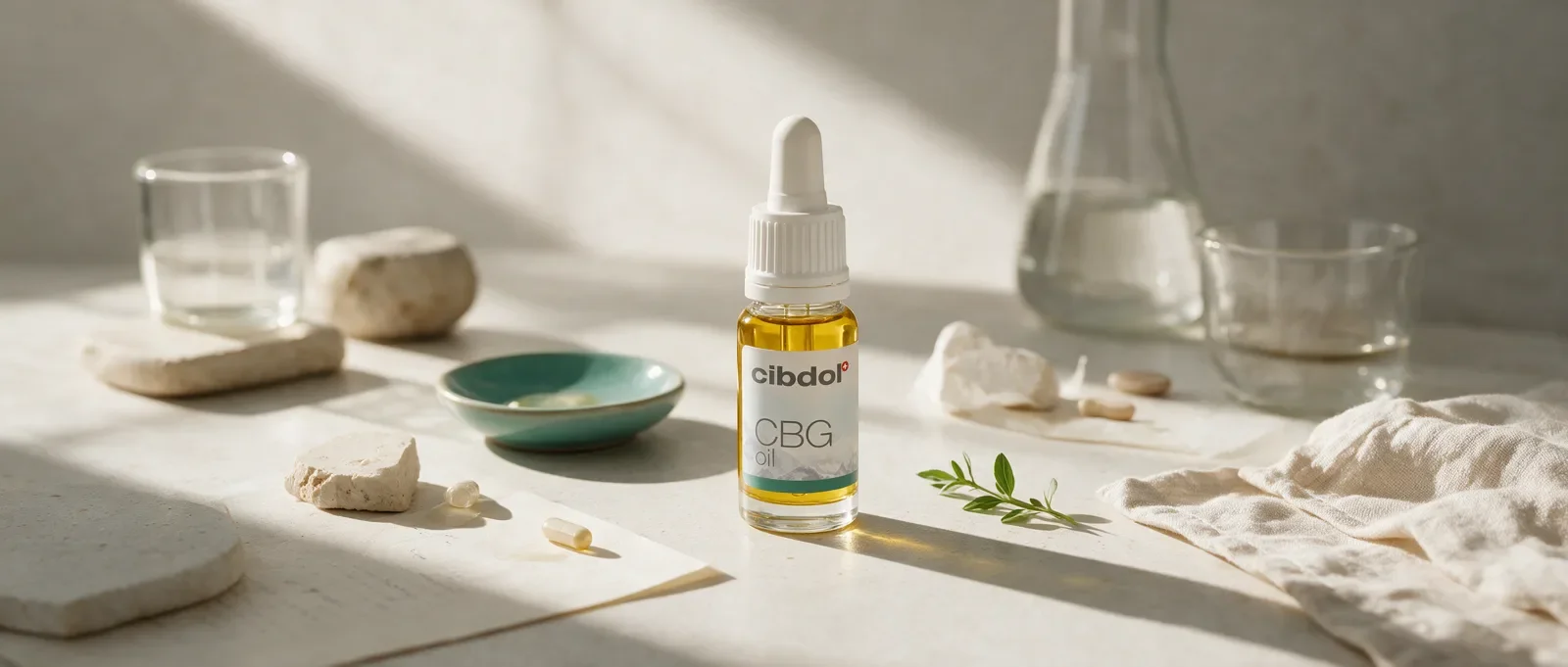
To see how this cannabinoid is formulated in finished products, the CBG oil category lists the available concentrations and bottle sizes.
The reaction itself was described in 1998 by Fellermeier and Zenk [1]. A transferase enzyme in hemp attaches a prenyl group to olivetolate, and the product is cannabigerolic acid. The same work identifies CBGA as the precursor of tetrahydrocannabinol [1]. So the acid isn't simply an early member of the group. It sits in front of it.
That position is the reason CBG gets called the mother cannabinoid. CBGA is the first cannabinoid acid hemp assembles, and it's the branch point for everything downstream [1]. Change what happens to that acid, and the plant's whole cannabinoid profile changes with it. The nickname is shorthand for a sequence, and the sequence has a citation behind it rather than a marketing origin [1].
- CBGA: the first cannabinoid acid formed in hemp, and the shared starting material for the lines that follow it [1].
- The step described in 1998 by Fellermeier and Zenk: a hemp transferase, a prenyl group, olivetolate, and cannabigerolic acid as the product [1].
- CBGA as the precursor of THC, which is how that 1998 work frames the compound's significance [1].
- CBG as the neutral form of the same molecule, and the name you see on labels and batch analyses.
- The wider family: cannabis catalogued by ElSohly and Slade in 2005 as a complex mixture of natural cannabinoids, not a plant with one or two active compounds [2].
Where all that acid goes
If the plant makes plenty of CBGA, why is CBG hard to find in a harvested crop? Because the plant spends it. A group of enzymes called synthases route CBGA down separate paths: one line leads to THCA, another to CBDA, another to CBCA [1]. Which line dominates comes down to cultivar genetics [1]. A CBD-rich hemp variety and a THC-rich cannabis variety start from the same acid. They just have different enzymes waiting for it.
By the time a plant reaches maturity, that conversion is largely complete [1]. Very little of the original acid is left. Mature plants retain under 1% CBG [1]. Nothing has gone wrong in the field. The starting material became something else, exactly as the biosynthetic route predicts [1]. That single number explains most of what people notice about CBG: it shows up in small quantities in standard hemp analyses, and material with CBG as its headline cannabinoid tends to come from an early harvest or from a cultivar chosen for its enzyme profile.
Under one percent, and why the figure moves
Read that under 1% as a working figure rather than a physical constant. Three variables shift it: the cultivar, the growing conditions, and the harvest date [1]. Take a plant early and more of the acid is still in its original form. Let it finish and the synthases have had their full run [1]. This is also why one grower's number and another's rarely match, and why a percentage measured in plant material tells you very little about the percentage in a finished oil. One describes biomass. The other describes a formulation, measured batch by batch.
What the percentage actually measures
| Figure | Number | What it refers to |
|---|---|---|
| Percentage, defined | weight ÷ volume | A label percentage is cannabinoid weight divided by bottle volume. It's a ratio between the milligrams of cannabinoid inside and the millilitres they're dissolved in, which is why the same milligram total reads differently in a larger bottle. |
| CBG content | 500 mg per 10 ml | Cibdol's CBG oil holds 500 mg of cannabigerol in a 10 ml bottle. Run the division and 500 mg in 10 ml reads as 5%. The percentage isn't a grade or a rating. It's arithmetic on two printed numbers. |
| CBD content | 250 mg per 10 ml | The same bottle carries 250 mg of cannabidiol, which reads as 2.5%. Two cannabinoids, listed separately, each with its own figure. Nothing on the label combines them into a single headline number. |
| Bottle volume | 10 ml | At ten millilitres, millilitres and percent line up without any conversion step, which makes the label unusually easy to check. Compare a 10 ml and a 30 ml bottle and the milligram total matters more than the percentage. |
| Carrier | Olive oil | Cannabinoids are oil-soluble, so they need an oil to sit in. Olive oil is food-grade and stable, which is why it does the carrying job here rather than something more exotic. |
| THC | 0.000% | The batch certificate for this oil lists THC at 0.000%. That figure is measured per batch and published, so it can be read before the bottle is opened rather than taken on trust. |
A mixture, not a single compound
In 2005, ElSohly and Slade catalogued the chemical constituents of cannabis, and the framing is the useful part: the plant reads as a complex mixture of natural cannabinoids rather than a source of one or two active compounds [2]. That's the context CBG belongs in. It isn't a rival to CBD. It's another entry in a family that the 1998 biosynthesis work traces back to a single acid [1].
Our formulation follows the same logic. Two cannabinoids in the bottle, 500 mg of CBG alongside 250 mg of CBD in 10 ml, rather than one compound stripped out and bottled on its own [2]. Olive oil carries both. The batch certificate lists the THC figure at 0.000%.
Cibdol has been working with cannabinoids since 2014, which is long enough to know which parts of this story are settled and which are still being written. The biosynthetic route is settled plant chemistry, published and widely cited [1]. The catalogue of constituents is documented [2]. Human research on CBG specifically is a younger field with far less behind it than CBD, and we would rather say that plainly.
What stays open
Three limits sit around the two works cited here. The 1998 study describes an enzymatic step inside the plant and maps a route, not a response in people [1]. The 2005 catalogue is an inventory of compounds present in the plant, and presence in an inventory is not a measured outcome [2]. And the under 1% figure describes harvested plant material, not the contents of a bottle, where the numbers come from a batch analysis instead [1]. Research is still running. When the evidence moves, the wording here moves with it.
Source, scope, and what's missing
| Source or figure | What it covers | What it does not settle |
|---|---|---|
| Fellermeier and Zenk, 1998 [1] | The enzymatic step that produces cannabigerolic acid in hemp, from olivetolate and a prenyl group, plus CBGA's standing as the precursor of THC. | A plant biochemistry study. It maps a route inside the plant and does not report anything measured in people. |
| ElSohly and Slade, 2005 [2] | A catalogue of the chemical constituents of cannabis, describing the plant as a complex mixture of natural cannabinoids rather than a single-compound source. | An inventory study. It records which compounds are present and in what chemical families, not what any one of them does. |
| Retention under 1% [1] | The share of CBG left in mature plant material once conversion through the synthase lines is largely complete. | A working figure across cultivars, growing conditions and harvest dates in the cited study, not a fixed constant, and not a statement about any bottled oil. |
| The label figures | 500 mg of CBG and 250 mg of CBD in 10 ml, read as 5% and 2.5%, in an olive oil carrier, with THC listed at 0.000% on the batch certificate. | Composition, verified per batch. Cibdol has worked with cannabinoids since 2014, and human research on cannabigerol is still developing. |
Frequently Asked Questions
4 questionsWhy is CBG called the mother cannabinoid?
How much CBG does mature hemp contain?
What does 5% mean on a 10ml bottle?
Why pair CBG with CBD instead of bottling CBG alone?
About this article


Luke Sholl has been writing about cannabinoids, CBD, and the broader benefits of nature since 2011. His background includes first-hand cannabis cultivation experience spanning the full seed-to-harvest lifecycle across so
This wiki article was drafted with AI assistance and reviewed by Luke Sholl, CBD & wellness writer. Editorial oversight by Joshua Askew.
Medical disclaimer. This content is for informational purposes only and does not constitute medical advice. Consult a qualified healthcare provider before use of any substance.
Last reviewed 26 серпня 2026 р.
References (2)
- [1]Fellermeier, M. and Zenk, M.H. (1998). Prenylation of olivetolate by a hemp transferase yields cannabigerolic acid, the precursor of tetrahydrocannabinol. DOI: https://doi.org/10.1016/s0014-5793(98)00450-5
- [2]ElSohly, M.A. and Slade, D. (2005). Chemical constituents of marijuana: the complex mixture of natural cannabinoids. DOI: https://doi.org/10.1016/j.lfs.2005.09.011
Related Articles
Does CBG Make You Sleepy? What's Actually on Record
The idea that cannabigerol brings on drowsiness is widely repeated, but the 2021 review by Nachnani and Barrett describes receptor sites rather than sensations in volunteers. The same thing happened to CBN, and Corroon traced it in 2021.
THCA vs THC: A Single Carboxyl Group Apart
One carboxyl group separates the acid form found in the plant from the neutral compound most people talk about. Here is what happens when it goes, and why two lab figures from one plant are not a contradiction.
Broad Spectrum CBD: What The Term Covers
Broad spectrum sits between full spectrum and isolate, and it's the one name on that list with no legal definition behind it. Here's what the term commits to, what research covers, and what our own range holds.
THCP: A Cannabinoid With Two Extra Carbons
Tetrahydrocannabiphorol turned up in an Italian medicinal cannabis variety in December 2019, in work led by Cinzia Citti [1]. Here is what that report actually records, and where our own range sits.
CBD Research: What the Human Data Covers
A calm look at what has actually been measured in cannabidiol studies, where the published record thins out, and what to check before you believe a claim.
Serotonin, 5-HT and the One Cannabinoid Link on Record
5-HT is not one receptor but at least seven families of them, each split into subtypes. Here is what that means for reading claims, and what the 2005 in vitro report on cannabidiol at 5-HT1a does and does not cover [1].
PEA and Anandamide: A Family Resemblance in Chemistry
Palmitoylethanolamide shares a chemical class and a clearance route with anandamide. Here is what that family resemblance settles, and what it deliberately leaves open.
The Endocannabinoid System in Six Papers, 1964 to 1995
The structure of THC was published in 1964, the first cannabinoid receptor in 1990, anandamide in 1992. Six reports, thirty-one years, and a name that runs backwards.
2016: What Clinical Endocannabinoid Deficiency (CECD) Actually Means
CECD is a testable idea about underactive endocannabinoid signalling, set out most clearly in a 2016 paper by Russo [1]. Here is what that paper names, and where the record stops.
